


When consumers picture themselves celebrating the winter holidays this year, one thing is clear: Most of them are surrounded by loved ones. Resonate data shows that for 78.1% of Americans plan to spend the holidays with immediate family, while 25.5% will see extended family and 25.8% are looking forward to plans with good friends.
Of course, all that togetherness often requires travel, and there’s a huge opportunity for travel-related brands to be a huge partner this holiday season…if they can understand what’s motivating their customers.
In this blog, we’ll explore how much consumers are thinking about spending on these future plans, as well as three data-backed strategies you can use in your holiday travel marketing campaigns this year.
How Much Are Consumers Planning to Spend on 2026 Holiday Travel?
Even though it’s only September, it’s crucial to pay attention to consumers’ holiday travel plans now. Americans have been thinking about whether they’re going to go anywhere during the winter holiday season since at least July, and Resonate data shows that between July and August 2026 alone, the percentage of people who decided they would stay home for the holidays rose from 54.0% to 55.2%.
Between those same two months, something else interesting happened: Spending intent among those who will be taking a trip during the holidays shifted upward. In the graphic below, you’ll notice that while the two lowest spending brackets both declined between July and August 2026, two of the higher tiers ($2,000-$2,999 and $5,000-$9,999) grew.
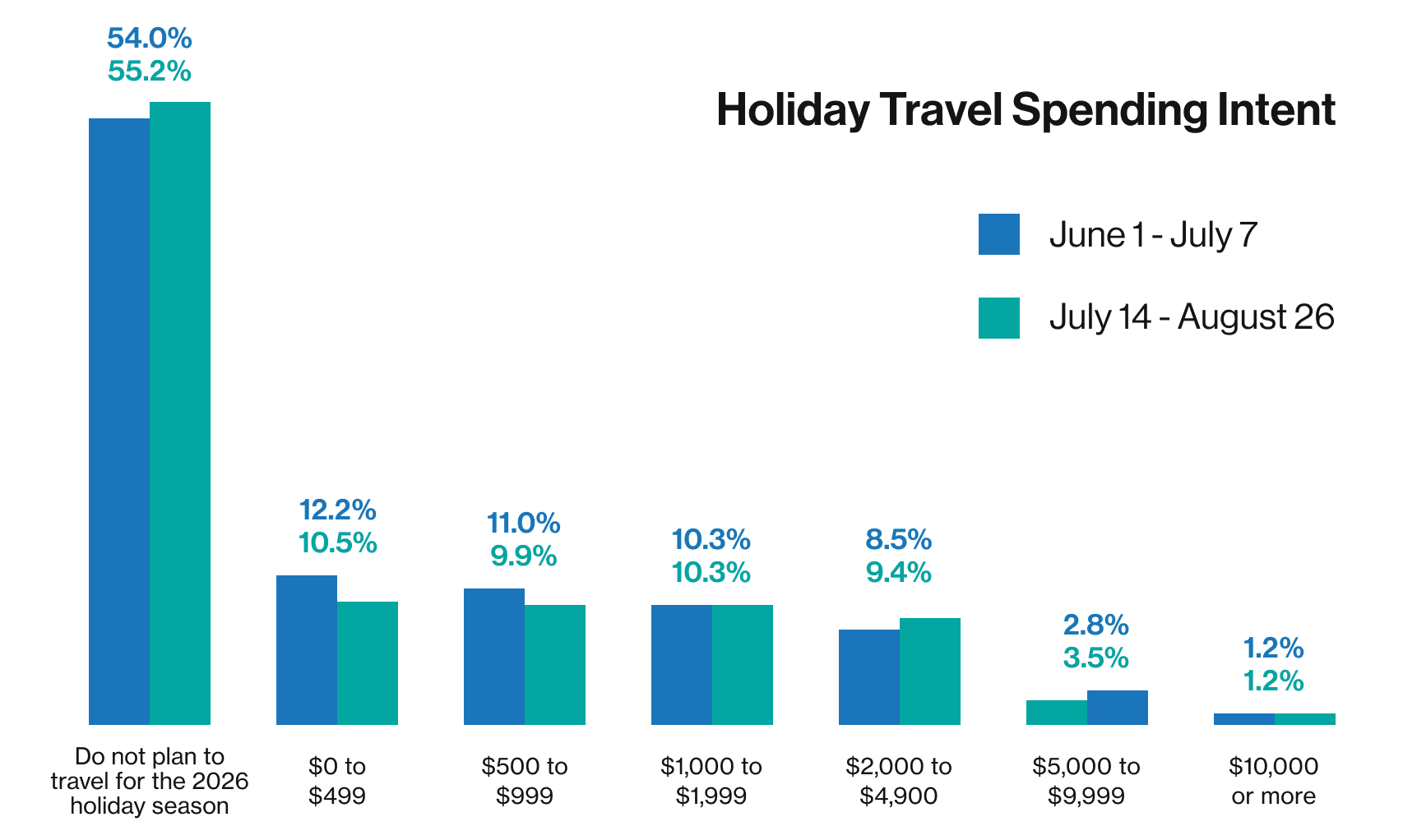
The change over a short period—just one month—is a signal that holiday plans aren’t set in stone until the customer hits “book.” So don’t treat your marketing campaigns as settled. Make sure you’re continuously monitoring available planning data and that your creative is adaptable throughout the holiday season. Think of it this way: Holiday travel is an active booking season (and needs active, not automatic, campaigns) until the holiday itself is over.
Here’s another trend: Fewer people are looking for cheap travel. If they’re really concerned about their budgets, they’re staying home. If they’re the kind of person who prioritizes the trip and gets deeper value from the experience, they’re simply choosing to spend more on their vacations, not less.
There’s also another way to look at this data. Instead of taking a bunch of inexpensive trips throughout the year, some travelers are consolidating their plans into one big, pricey vacation. Since they’re already prepared to spend more and are likely to think of the trip as “treating themselves,” meet them with upgrade offers, premium accommodation messaging, and multi-destination trip packages.
3 Strategies Marketers Should Keep in Mind This Holiday Season
Strategy 1: Segment by intent to spend, not just intent to travel.
If you rely on a binary “will they or won’t they travel” targeting model, you’ll miss the fact that among consumers, budget tiers are actively shifting all the time. And as you saw earlier, the shift isn’t always just to “spend less.” Without data that shows you what travelers intend to spend, you won’t notice when they’ve moved into a bracket that should trigger a specific marketing message (like a premium tier for a customer who decided that this year, they’re going to spend over $6,000 instead of between $2,000 and $4,000).
Strategy 2: Reconsider entry-level offers.
Everybody’s aiming for the bigger spenders, but the truth is, there aren’t as many of them as there are travelers collectively spread across the other budget tiers. But when most marketing efforts target only luxury customers, that leaves an enormous percentage of the population who isn’t being contacted by, well, anybody. Don’t throw those entry-level offers away. Instead, rethink them: You may need one entry-level offer that speaks to that huge 55% of consumers who need a reason to travel, and one that engages the wallet-conscious customer who is already in-market but looking to spend less.
Strategy 3: Focus holiday travel messaging on the immediate family.
Three-quarters of consumers plan to spend their 2026 holidays with immediate family, so lean into this data when you’re working on your campaigns. Packages, room configurations, and creative built around a core family unit will resonate more broadly than options for those with large extended families or who are going on trips with their friend group. These latter two groups should be segmented and addressed separately.
Ready to Track These Shifts as They Happen?
Holiday travel intent didn’t stop moving after August, and it won’t stop moving before December, either.
Resonate’s continuously updated predictive consumer intelligence tracks these spending and travel shifts as they happen, so your team can catch a bracket change before a competitor does. To learn more about the ways to incorporate our data into your business strategy, schedule a consultation with a Resonate data expert today.