

Synthetic data has rapidly graduated from an interesting idea into something marketers are using to drive decisions, build pipeline, and grow revenue right now. But for brands, agencies, and political advocacy teams racing to keep up, there remain a number of important questions: Where does synthetic data work best? How do you know the outputs are right? What should you ask before you put budget behind it?
In our recent webinar, Forrester Analyst Zeid Khater, Resonate VP of Data Science and Machine-Learning Engineering Corey Mull, and CMO Meredith Albertson provide you with answers drawn from world-class research and real-world experience.
Here are three key takeaways from the session.
Takeaway 1: Not all synthetic audiences are built the same, and the data they’re based on makes or breaks their value
The broader market uses terms like synthetic personas, synthetic panels, and digital twins almost interchangeably. Khater argues that what matters more than the label is how the audience is built: “For the most part, the more data that it’s grounded in, the more accurate the responses are likely to be.”
He walked through a ladder of four build types, from least to most grounded:
- Synthetic wrapper: a large language model with some prompt engineering, drawing only on public data.
- Synthetic with RAG (retrieval-augmented generation): the model gets real response data as a reference before it answers.
- Fully grounded synthetic persona: adds demographic or aggregated customer data, such as age, income and gender identity.
- Digital twin: all of the above, plus a persistent connection to a real individual.
Khater also points out some of the red flags to watch out for when considering a synthetic solution, including responses that can be “middle out” as less varied, can tend toward uneven representation, or behave too rationally relative to real respondents.
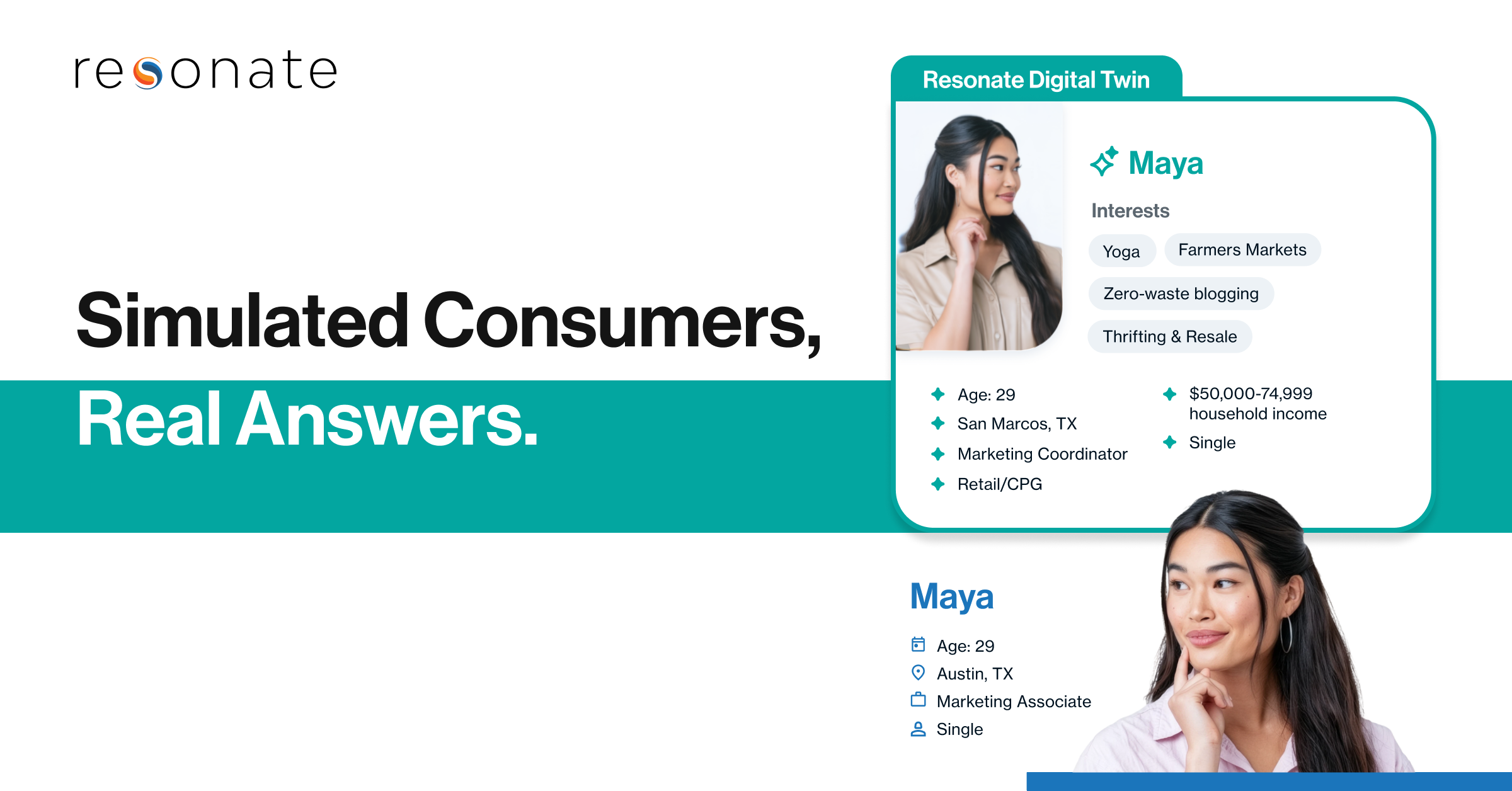
These limitations informed the build for Resonate Digital Twins, Resonate’s synthetic panel offering. As Mull explains, “Every single Digital Twin that we create is a real person in our graph,” and it draws on ID-matched profiles from more than 250 million US adults, more than 100 million fielded study responses, 30 billion daily web behaviors, and 15,000 attributes.
What to ask any vendor
During Q&A, both speakers gave practical advice for evaluating synthetic data providers. Mull says the first question is simple: “How do you know your answers are right?” This helps you validate precisely what information goes into building a digital twin and how robust it is.
Khater suggests adding a test to your evaluation process. “Give [your vendor] the questionnaire to a study you’ve already conducted”, he explains, allowing you to compare the synthetic results with what answers you already have and check for accuracy.
Takeaway 2: Synthetic data is built for speed and reach, and it pays off where those matter most
When companies decide to try synthetic research, one of the most common reasons is speed. Cost is close behind, since teams can skip paying for a panel every time they run a pulse survey or brand study.
Khater shared a few case studies to demonstrate the value. Gabb Wireless, which sells kid-safe phones for ages 8 to 16, serves an audience that’s notoriously hard to survey. Using synthetic responses for research on parental controls, “they cut their time to insights from 7 days to 4 hours. That’s huge.” Gabb also cut costs by 50% compared with a traditional third-party panel.
Reach matters just as much. Booking.com wanted to study smaller traveler segments without lengthening its survey or recruiting thousands more people. Synthetic responses helped it separate solo travelers who travel alone to meet others from those who simply want a solo trip, “a very nuanced thing to be able to suss out.”
More broadly, he noted that, “With simulated audiences, you get a lot of edge cases and edge people that wouldn’t otherwise really be in your data,” which can provide you more specific insight and also help with the problem of small sample sizes for key segments.
Khater summed up where synthetic tools earn their keep:
- Early-stage screening to weed out weaker options before spending on real participants
- High-velocity iteration when recruitment timelines would slow the team down
- Edge cases and hard-to-reach segments
He was also clear that synthetic data adds to traditional research rather than replacing it: “I don’t see synthetic tools as a replacement for traditional research.” Teams get the most from both when they use synthetic data to test more ideas earlier, then save real-world validation for the biggest bets.
Mull described how Resonate Digital Twins supports these efforts. Resonate delivers within five days, at a cost low enough to rerun the study when the question changes. That matters because, as he put it, “I’ve never been in a market research project where there were not follow-up questions.”
Takeaway 3: The real payoff comes when synthetic insight turns into action
According to Forrester research, 26% of data and analytics decision-makers say it takes too much time to incorporate insights into decision-making. Faster research is a starting point, but the bigger opportunity with synthetic data comes from what you do with it beyond the research phase.
Khater urges teams to build synthetic tools into existing workflows so that it becomes integrated with process instead of being viewed as a separate step or function.
That’s also the idea behind Resonate’s Digital Twins. Because every twin is tied to a real, ID-matched person, the answer to a question becomes an audience you can activate and put budget behind. This makes it easier to blend the outcomes of research with your paid media or campaign teams, extending the value of synthteic investment. “What you get out of this process is an attribute on every individual,” explains Mull, which can be delivered as audiences you can target directly.
Put synthetic data to work
Synthetic data drives value when it’s built on real evidence, used where speed and reach matter, and connects to the campaigns that follow from it. Marketers who get all three right can move from “should we try this?” to results they can measure.
If you missed the session or want to revisit it, watch the full, on-demand recording. And if you’d like to see how Resonate Digital Twins can answer your next question and turn it into an audience you can activate, schedule some time to discuss it with our team.