
Key Takeaways:
- Forrester identifies several ways synthetic data is already being used in customer analytics, from building fuller customer profiles to powering digital twins that predict reactions to new topics.
- The most marketing-relevant uses fill gaps: thin customer data, hard-to-reach audiences, shortened surveys, and questions nobody has asked yet.
- Synthetic respondents are a supplement to research with real people, and results are only as good as the real data underneath.
- Teams that start with a specific use case and a trusted provider will get value faster than those that treat synthetic data as a general-purpose tool.
Consumers today are evolving faster than ever, and that’s impacted marketers in some big ways. For one, the questions teams need answered move faster than they used to. Unfortunately, traditional customer data isn’t up for the challenge. Not only does it lack the depth needed to provide rich insights about new or niche segments, but it can’t cover things like how customers will react to something they’ve never seen.
It’s simply not realistic to run an expensive, time-consuming research study every time your team has a new question about an audience. That’s where synthetic data comes in.
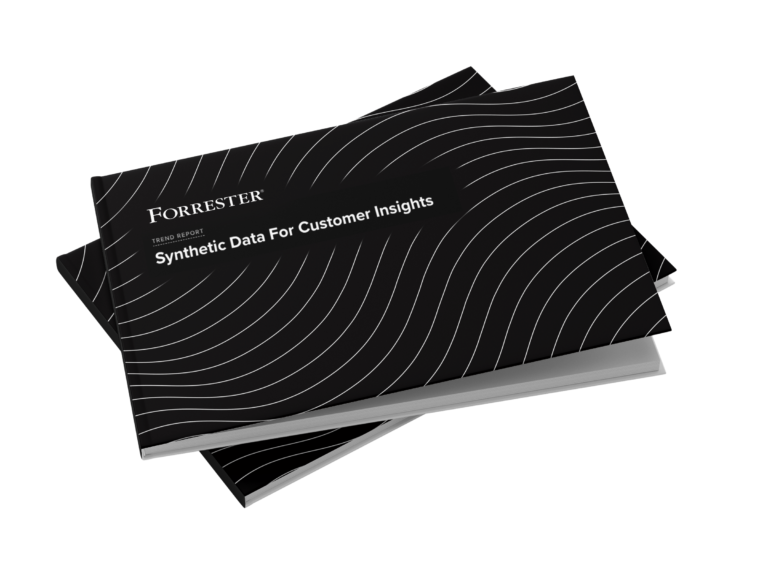
While it’s new to marketers, synthetic data has actually been around for years. Mostly, data scientists used it to protect privacy or address data gaps. Now, as a recent Forrester report shows, with the help of AI, synthetic data can capture complex, real-world patterns and scale without someone writing every rule by hand. This flexibility is why synthetic data is showing up in more customer analytics and marketing conversations.
The presence of synthetic data in the marketing profession gives rise to a new question: How can marketers use it? In other words, what are the use cases? In this blog, we’ll talk about four ways synthetic data is being used in marketing today, as well as what each one means for marketers.
4 Synthetic Data Use Cases for Marketers
Use Case 1: Building fuller customer profiles for prediction
Interest in next-best-experience analysis is growing. Forrester’s Digital Business Strategy Survey found that 47% of digital business strategy decision-makers say their firm plans to invest in the next two years, up from 32% the year before.
As marketers’ attention turns from backward-looking data to predictive insights and models, the type of data they need to get the results they want is changing. Take some of the most valuable marketing models available as an example. Next-best-action models predict the right offer or message for a specific customer, while customer lifetime value models predict how much a customer will be worth to a brand over time. Both depend on a significant amount of detailed data to work well.
Synthetic data helps by filling in the gaps. It can simulate realistic customer profiles and add to real data, giving models more to learn from. According to Forrester, customer analytics firms are already using synthetic data this way to improve lifetime value predictions, which in turn sharpens decisions about acquisition, retention, and where to spend.
What it means for marketers: If your personalization or retention models are limited by how much customer history you have, synthetic data can help them perform better, especially for newer customers or segments where data is sparse.
Use Case 2: Filling in gaps in market research
Traditional market research has its benefits, but it’s also slow and expensive. Furthermore, it’s tough to find the right respondents in emerging markets or niche categories. To get around these challenges, Forrester notes new providers are pairing synthetic data with large language models (LLMs) to create synthetic respondents who can answer surveys and react to concepts, content, and designs.
This is one of the most-talked-about uses for synthetic data right now. According to Forrester, creating synthetic customers is a promising route to supplementing traditional research.
What it means for marketers: The advantage with synthetic respondents is that you can get a fast read on the direction you should take a concept or message before you commit budget. Similarly, synthetic data can also help you explore a segment that’s too small or costly to survey.
Use Case 3: Filling in gaps in shorter surveys
Lately, the trend has been for CX and insights teams to keep surveys short. While the intended goals of improving response rate and data quality are laudable, there’s a painful trade-off. Every question you cut is information about customers that’s lost.
With the advent of synthetic data in marketing, there’s now a solution, Forrester says. Teams can include only essential questions in the actual survey and then use predictive augmentation techniques to predict the missing responses. The result: A more complete dataset, sans the long survey that nobody’s going to finish.
What it means for marketers: You no longer have to choose between a survey people will finish and a complete dataset that gives you the insights you need to act. Predictive augmentation lets you keep surveys short and still get the depth you need for segmentation and analysis.
Use Case 4: Strengthening fraud detection models
Depending on which industry you work in, your business could be impacted by fraud. According to Forrester, for instance, the financial services industry lost over $10B to fraud in 2023. As fraudsters become more sophisticated, synthetic data can help teams improve fraud model precision, build better systems to detect fraud, address data scarcity, and improve balance in fraud datasets.
What it means for marketers: Synthetic data can give a model enough examples to learn from. Marketers can apply it to events they want to predict, like churn among high-value customers or conversion in a long purchase cycle.
The Bottom Line: Synthetic Data Still Depends on Real Data
No matter which use case is of most interest to you, Forrester is clear on one common thread. Synthetic data requires high-quality original data to produce results that stay true to real-world patterns. In categories where real customer data is scarce or heavily regulated, generating realistic synthetic data is much harder.
Here’s what that means: The first thing you need to do when you’re considering synthetic data is evaluate the source. A synthetic dataset built on thin, biased, or legacy data will repeat those problems at scale.
Forrester also recommends a few practical steps for getting started:
- Pilot first. Test a specific use case before rolling synthetic data out broadly.
- Partner with a provider. Building synthetic data in-house requires time, expertise, and dedicated resources. An experienced partner can shorten the time to useful results.
- Bring in domain experts when real data is scarce or regulated.
- Educate governance and procurement teams early, since many organizations don’t yet have rules for evaluating or approving synthetic data.
Answer Your Next Audience Question in Days, Not Months
Resonate Digital Twins are built to answer new questions quickly while staying grounded in real people. Each twin is built from one real, ID-matched person’s data, and results are validated against real evidence before delivery. Answers arrive in about five days and become an audience you can put media behind, rather than stopping at a report.
Ready to learn more? We have a blog that will walk you through Resonate Digital Twins. Ready to talk about how synthetic data will help your business thrive? Schedule a consultation with a Resonate data expert today.
Frequently Asked Questions
What is synthetic data in marketing?
Synthetic data is artificially generated data that reflects the patterns of real data without being collected directly from real people. Marketers use it to fill gaps in customer data, research, and surveys.
Can synthetic respondents replace traditional market research?
Not yet. Forrester describes synthetic respondents as a promising supplement to traditional research, not a replacement for research with real people. They work best for fast, directional reads.
What is a digital twin?
A digital twin is an AI model of a specific customer profile, built to predict how that customer will behave, including how they’ll respond to new products, topics, or messages they haven’t seen before.
What’s the biggest limitation of synthetic data?
It depends on the quality of the real data it’s built on. If the source data is thin, biased, or outdated, the synthetic data will repeat those problems.