


Key Takeaways:
- Synthetic data is only as reliable as what it’s built on. Look for responses grounded in real, individual-level data.
- Before you buy, ask vendors what their data is built on, whether their audience is representative from the start, and whether they’ll calibrate to your own research.
- Synthetic data can flatten real consumers into a blurry average or tell you what you want to hear. Be cautious of results that look too uniform or too positive.
- Four questions separate credible vendors from the rest: how they prevent agreeable answers, how they handle question wording and order, how they validate results against evidence the model never saw, and whether you can see the reasoning behind each answer.
- Synthetic data works best for established categories, values and preferences, testing described concepts, and hard-to-reach segments. It isn’t the right tool for brand-new categories, breaking news, awareness measurement, or ongoing tracking.
Synthetic data has moved quickly from being used mostly by researchers to becoming a more common component of marketing strategies. Brands are using it to test and predict performance before an ad runs, and agencies are sharpening pitches without commissioning a full study. The appeal is clear: You can get answers in days instead of months and at a fraction of the cost of traditional fieldwork.
But as acceptance of synthetic data in marketing grows, so too does skepticism. Some of the early products simply didn’t work, and marketers worry that even if a solution does work, the results will be misleading. These are understandable concerns.
To ensure your foray into synthetic data is a success, there are three important tips you should keep in mind. In this blog, we’ll go over not just these tips, but also how Resonate Digital Twins, our synthetic-data offering, will handle some issues other vendors have and ensure you use synthetic data to drive growth.
Tip 1: Check out what the synthetic data is built on
The model used to create synthetic data learns patterns from real data given to it by a person, and it generates new records that follow those patterns. That means gaps, skews, and quality issues that are in the source data will be carried over straight into the output. Even though you need a large, high-quality baseline of real data to generate reliable synthetic data, some inexperienced vendors tend to simply overlook this requirement.
The big takeaway is that the source of synthetic data matters a lot. Generally, it tends to come from one of three places:
- A general AI model. You can ask a chatbot how a specific type of consumer feels about something, and it will give you a plausible-sounding answer based on broad patterns in its training data. But there’s no real person behind that response and no way to trace it back to anything concrete.
- A research panel’s past responses. This source is more reliable than a general AI model because it reflects people who were actually surveyed. But it’s limited by who joined that panel and stayed active, and any coverage gaps or research bias will be brought into the synthetic layer.
- Real, individual-level data tied to actual people. This is the gold-star approach. It builds each synthetic respondent from a specific person’s measured attributes and behaviors rather than from a demographic label or a group average.
What you can do
The key here is to do your research before you buy. When you sit down to a demo with a vendor:
- Ask what their synthetic data’s foundation is and how individual that grounding is.
- Ask if their audience is representative from the start, calibrated to census benchmarks, or adjusted after the fact.
- Bring your own research. Credible vendors will treat your surveys or focus group findings as input and calibrate to them so the synthetic data builds on what you already know.
Tip 2: Make sure your vendor isn’t telling a story that’s more agreeable than reality
Real consumers are a host of contradictions. Their views are often not entirely clear to marketers because they’re based on an incongruous mix of personal values, life experiences, and content they’re seeing on a social media algorithm. They may react differently to the same offer depending on the source, price, timing, and context.
That messiness is often the source of the most useful insights about them. Unfortunately, synthetic data can sand all of that away, turning many versions of consumers into one blurry composite. And if the model is too basic, it may miss certain cues in the data such as price-sensitivity curves or distinct clusters that behave like segments.
And there’s a second version of this issue: The generic AI models many marketers use to produce synthetic respondents tend to have a habit of telling people what they seem to want to hear. That makes it difficult to objectively tell if a concept looks stronger than it actually is or if a weak message is testing better than it should.
What you can do
If the output looks too uniform or too positive, it probably is. Ask the vendor three specific questions:
- How do you handle question wording and order? These can skew synthetic results the same way they skew a live survey. Serious vendors will rotate answer options, test wording variations, and ask each synthetic respondent more than once.
- How do you validate the results? Because a model will naturally agree with the data it was built on, it’s important to validate using information the model hasn’t seen yet, but that you can independently verify. Only a match against evidence the model never saw shows the results are more than an echo. If synthetic data is right about the answers you can already check, you have a reasonable basis for trusting it on the ones you can’t.
- Can I see the reasoning? Always ask for an explanation beyond a number on a chart to be sure the logic holds up and that you understand it.
How Resonate Digital Twins answers these questions
As a vendor, we face these kinds of questions every day, and we built our synthetic offering, Resonate Digital Twins, with them in mind.
With Resonate, every twin is grounded in a real person’s measured attributes, so the model isn’t free to improvise. Real evidence sets targets for each small group of people, meaning how many in that group should hold each view. Those targets are applied to the twins’ answers afterward and are never fed to the AI; that means the parameters set by evidence keep the AI model from generating a more agreeable response than reality.
That’s the starting point for Resonate Digital Twins. Here’s how it handles the other questions on your list:
Question wording and order
Resonate treats wording and order the same way a live survey would. Answer options are rotated, wording variations are tested, and each twin is interviewed more than once, so the results don’t depend on one particular phrasing or sequence.
Validating results
Every build is checked against real evidence the model never saw. Resonate holds back answers it already has from its own fielded studies, a customer’s research, or public benchmarks, then asks the twins the same questions. Every build follows four rules:
- Benchmarks are written first. Pass/fail rules are set before the model is built, so the goalposts can’t move.
- Every build is held out. A build ships only if it beats the held-out evidence.
- Predictions are locked. Each one is timestamped when it ships, so it can be tested later against a lift test, a past campaign, or the customer’s own survey, and Resonate reports the result either way.
- Results are traceable. Every score traces back to the individual and the evidence behind it.
In an internal test, the pipeline predicted answers to 35 US Consumer Study questions it had never seen, with an average 94.2% similarity to fielded research. Results ranged from 84.3% on the importance of cultural heritage to 99.6% for customers of a major insurer.
Transparent reasoning
Every twin answers in its own words and gives plain-English reasons for its choice, so you can see the logic behind each result rather than just a number. Verbatim reasoning is one of the deliverables, alongside the audience, a summary report, and run diagnostics covering sample size, attributes, and calibration.
Tip 3: Use synthetic data for the right job
Synthetic data is a powerful addition to your marketing toolbox, but it’s not a wholesale substitute for all the other data types at your disposal. Nor is it always the right lever to pull for every situation. Here are a few contexts in which synthetic data may not be the best fit:
- Brand-new products, categories, or topics: Without existing research or history to draw on, synthetic data can’t reliably predict reactions.
- Breaking news or real-time events: If you have a question about something that just happened, you need measurement that works in real time.
- Awareness measurement: Synthetic data can’t tell you whether someone has actually heard of, seen, or recognized something, like a brand or an ad.
- Ongoing tracking: Synthetic data can’t replace a tracker you field again and again.
- Decisions that require a real human baseline: When a decision truly depends on a human baseline, validate the critical questions with fielded research.
What you can do
Start with the decision you need to make, then choose the right method for getting an answer. Synthetic data tends to perform best on established categories, where existing research and behavior give the model a strong foundation. It also does well on questions about values and preferences, on testing described messages, offers, and concepts before spend is committed, and on reading segments that a traditional panel can’t reach quickly or affordably.
Ask each vendor to talk to you about the limitations of their synthetic data and for them to be specific about what it’s not good for. It’s important info for you, but it also helps weed out the vendors that over-promise or may not have the right expertise.
Ready to find out if synthetic data is right for you?
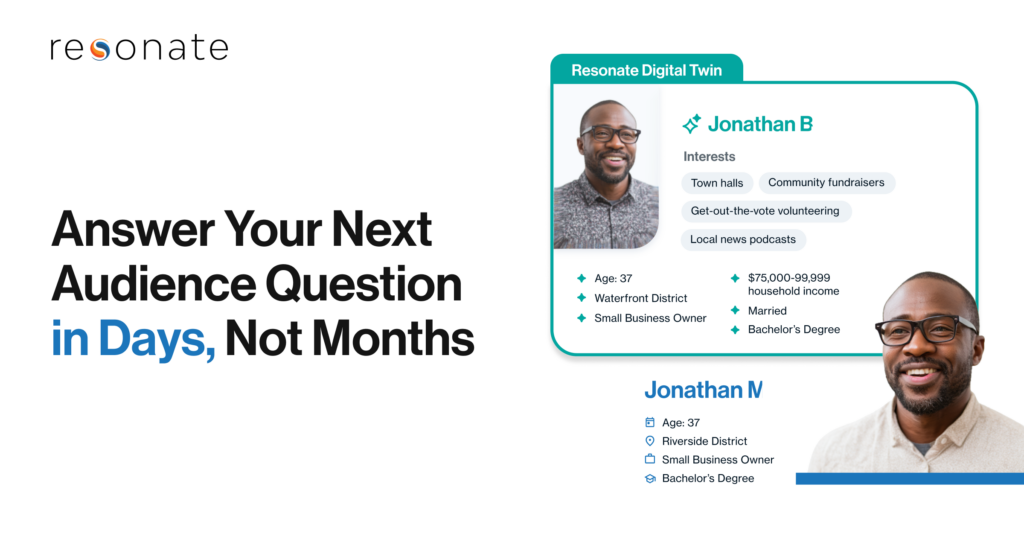
As synthetic data is used more in marketing, its uses and limitations will become clearer. Resonate Digital Twins was built to specifically address the areas where other synthetic products fall short. Resonate Digital Twins is a synthetic panel based on real individuals:
- Built on a robust identity graph of directly collected data from more than 1 million people, drawn from more than 100 million responses to our continuous US Consumer Study and 30 billion daily observed behaviors
- Validated against decades of research and hold-out data, with results predicted across the entire US adult population for every individual
- Delivers real audiences made up of targeted individuals you can actually reach (not just a composite)
You can learn more about Resonate Digital Twins in this primer. If you’re brand new to synthetic data, head over to our introductory blog to learn what it is, what it’s used for, and how it can help your brand or agency.
And if you’re ready to ask us the hard questions about synthetic data, schedule a consultation with a Resonate data expert today. Our knowledge is grounded in nearly 20 years of experience working with all kinds of data, including synthetic, and we’ll be able to help you decide if synthetic data is the right move for your business.
Frequently Asked Questions
Is synthetic data the same as fake data?
No. Synthetic data is generated rather than collected directly from people, but credible synthetic data is built on real-world data and patterns. Its reliability depends on what it’s built on and how rigorously it’s tested, and that varies widely from one provider to the next.
Is synthetic data biased?
It can be. Synthetic data reproduces whatever bias exists in its source data and can also reflect the tendencies of the AI model generating it. Grounding in real, representative data and validating against independent evidence are the main safeguards.
Can synthetic data replace traditional market research?
Not entirely. It works best alongside fielded research, as a fast, directional read or as a way to test a question before fielding a full study. For new-to-world categories, breaking news, and awareness measurement, a real human baseline is still the better choice.
How can I tell if synthetic results are accurate?
Ask for validation against evidence the model never saw and ask the vendor to back-test against your own holdout data. Results that hold up on questions you can check give you a reasonable basis for trusting answers on questions you can’t.