


Key Takeaways:
- Campaigns ramp-up is not a single re-launch or adjustment to one plan. During the final stretch before an election, strategy, creative and budget decisions must happen simultaneously and run in parallel, not in sequence.
- A lean team can usually handle any one operational demand alone, but several at once is where campaigns lose ground that’s hard to recover.
- Resonate’s Managed Services team functions as a client partner, strategist, and campaign management on behalf of the campaign, with reporting live within 48 hours of launch and refreshed nightly.
- Documented results include a 277% improvement in targeting precision and a 64% increase in average dollars raised per email for one advocacy organization, and correct predictions of the presidential election winner in 2016, 2020, and 2024.
There’s probably some saying about “the best laid plans” we could start with here…but what political campaign has time for that right now?
In one of the most consequential election years of the century, the race is in the home stretch. Your “plan” now is whatever the campaign needs to finish strong, even if that means a huge ramp-up at the busiest time of the cycle. Often, that means doing more and doing it faster than your team was built for.
In this piece, we’ll cut right to the chase on understanding the high demands of the late-race ramp-up and what resources campaigns can invest in to deliver in this high-pressure environment.
The Common Demands of the Late-Race Ramp-Up
The late stages of a race often throw the same six common challenges at campaigns. Your team of experts is built to handle any one of them on their own. But when all six hit at the same time, even the pros can fall behind. Unfortunately, it’s also the moment when you can least afford it.
Here’s the six demands to look out for, and what to do about each one:
1. Retarget for the race you’re in, not the one you planned for.
As a race stabilizes, the “right” targeting goal often shifts. For example, you might find you need to move from persuading undecided voters to promoting turnout for those you’ve already convinced. That means rebuilding your audience, not just tweaking a message. Catch this shift as early as possible and reallocate toward turnout-focused targeting while there’s time to spend into it.
2. Close targeting gaps within days, not weeks.
During the race, it’s common to find entire segments, geographic areas, age groups, or specific voter files that are being under-reached. There is often rationale for these gaps in the earlier portion of the campaign, but now the fix has to happen in just a few days. This includes shifting budget, rebuilding audiences, and getting into market before the overlooked voters decide.
3. Make creative testing a daily habit, not a one-time step.
A message that worked three weeks ago can overstay its welcome as the race shifts. Testing daily rather than sporadically catches those shifts before they show up as a drop-off in performance and the damage is already done.
4. Build geofencing into the calendar as events get added.
Campaign events get locked late and sometimes change timing or location on short notice. Geofencing needs to go live within a day of a new event being confirmed; if your team is stretched beyond capacity, that urgency can be missed.
5. Keep the voter file current enough to stop wasting spend.
Once early voting starts, a file that isn’t updated daily means money spent reaching people who have already voted. Daily suppression keeps spend pointed at people still making up their minds.
6. Build in the capacity to move budget same-day.
Budget decisions late in a race often can’t wait for a normal planning cycle. What a team needs here is a process for reallocating money within hours as new information comes in. Experience and intuition can’t cover for a lack of process.
Making the Shift to a Dedicated Team
These challenges are exactly why Resonate’s Managed Services team exists.
Managed Services is built as a client partner of your campaign, a strategist to build the media plan, and a campaign-management function that runs day-to-day execution in conjunction with your expertise. Your judgement, experience, and know-how can’t be replaced; your lean team just can’t do all six things we outline at once…and “at once” is precisely when it’s needed.
The Resonate Managed Services works to create a media plan aligned with your campaign’s specific goals and budget. From there, the team will build audiences, traffic the campaign across the DSPs it needs to run on, and handle reporting. Performance data goes live within 48 hours of launch and refreshes nightly from there, broken out by channel, creative, and placement.
This takes six simultaneous “must dos” off your plate and gives you the visibility and assurance to see what’s working without waiting to pull the metrics manually.
Data built for constantly changing races
The extra set of hands is a great benefit during the home stretch, but the real differentiator of Resonate Managed Services during this compressed timeline is the data that informs the activity.
The targeting draws on Resonate attributes built specifically for the Politics and Advocacy space. This includes voter values, issue attitudes, civic engagement, and media consumption, all combined with DMA and Congressional District geography data.
That data refreshes nightly for activation. This means that a persuasion or mobilization audience reflects the race as it stands today, rather than relying on prior assumptions that may no longer apply at this stage in the campaign.
We call this kind of data predictive intelligence because it goes beyond demographics to capture the deeper motivations that influence voters and doners. Predictive intelligence also allows our Managed Services team to understand what those constituents will do next on your behalf.
The data advantage in action
Real-world examples show the difference this kind of constantly refreshed predictive intelligence can make on your campaign.
New Blue Interactive, an advocacy organization, used Resonate’s predictive modeling to score its donor file by likelihood to give, rather than treating every name on the list the same way. Most donor modeling in this space works backward, building lookalikes from people that already gave. Resonate’s model was forward-looking instead, scoring who was ready to give next based on what people really believed in and cared about in the moment.
That shift in how the data was used drove a 277% improvement in targeting precision with no increase in unsubscribers, proof the model was finding real signal rather than simply casting a wider net. This expanded the organization’s usable email universe by 68.9%, with the models themselves delivered within a week.
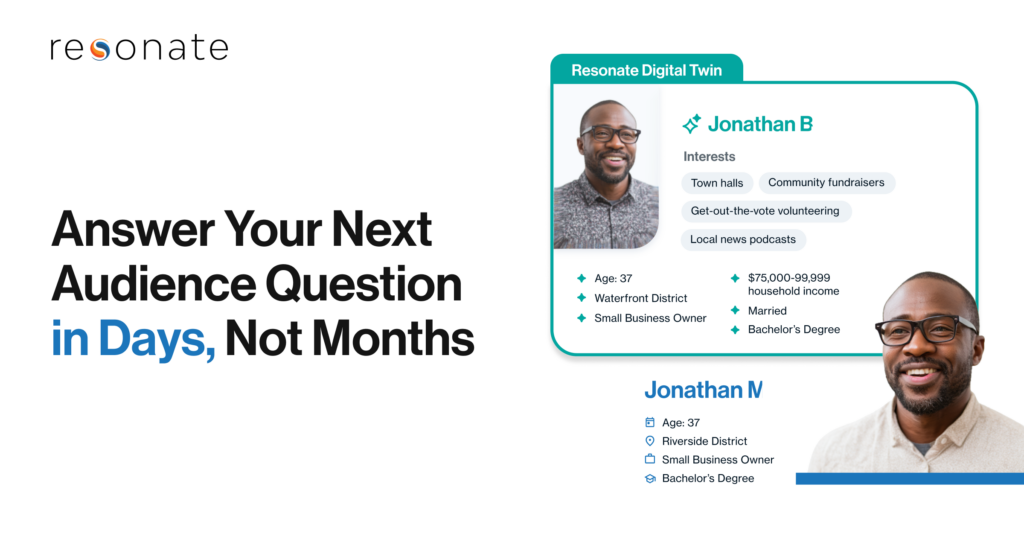
Resonate Digital Twins, a synthetic panel built on real individuals that delivers a real audience you can put media against, created data that was used to power a $5M campaign in the New York 12th Congressional District primary in which the candidate outperformed projections by more than 5%. Resonate data has also been used to successfully predict the 2016, 2020, and 2024 presidential elections.
Invest in Capacity, Not Just a Plan
The campaigns that hold up best in the final stretch are not the ones with the most polished plan. They are the ones that built enough capacity across targeting, creative, and budget to act on what unfolds in the race in days, not weeks.
If your own ramp up is starting to ask too much of your team all at once, you’re just one short conversation away from a dedicated team that can get you across the finish line. Schedule some time with us today, and get Resonate Managed Services on your side for the last big push.
Frequently Asked Questions
What is Resonate Managed Services?
This is a dedicated Resonate team, a client partner, a strategist, and a campaign-management function that builds, plans, launches, and optimizes a campaign’s media on behalf of you, the client.
How is Managed Services different from running a campaign in-house?
It takes on the execution workload, audience building, trafficking, optimization, and reporting, so an in-house team can keep its attention on strategy and the candidate rather than day-to-day media operations.
How fast does a campaign see results after launch?
Performance data goes live within 48 hours of launch and refreshes nightly, broken out by channel, creative, and placement.
What kind of data does Managed Services use for political and advocacy targeting?
Resonate Elements attributes built specifically for the Politics and Advocacy space, including values, issue attributes, civic engagement, and media consumption.
Managed Services also collects novel data from our synthetic-panel offering, Resonate Digital Twins. This allows campaigns to ask questions of their constituents that have never been asked before, get real answers grounded in directly collected data and predictions from more than 250M ID-matched US adults, and produces a real audience that you can put media against immediately.