


It isn’t news that consumer sentiment is flagging. Years of high prices, which have made it tough to save and difficult to get out of debt, have eroded confidence in the present and for the future.
This presents a challenge to brands looking to create revenue growth and agencies hoping to deliver for consumer-facing clients. Navigating a landscape like this one requires you to have insight into consumer sentiment beyond just the fact that it’s “negative.” A complete picture of the consumer that extends beyond their economic concerns gets to the heart of what motivates the purchases they do make right now.
Because despite the conditions, Americans are still spending money. They still need and want goods and services. What’s changed is what they look for from brands. They want to know that companies see and understand their financial pain. They want sales and deals, yes, but they also want high quality, easy buying methods and returns, knowledgeable staff, clean stores, and value for their money. These factors influence why they buy and who they buy from.
In this blog, we’ll take a deep dive into current consumer sentiment and offer some strategies to navigate it.
How Conflict in the Middle East is Affecting Consumer Sentiment
The ongoing conflict in Iran has Americans worried: 31.5% cited geopolitical concerns as being top of mind in the near future, a 15% increase in the last three months. And a significant 55% of consumers are now worried about gas prices, a 75% increase since March 2026.
That’s a significant jump, but it’s important to also look at this data point in the context of the bigger picture. The concern about high prices at the pump is just part of an array of worries that all neatly fit into two categories: concerns about affordability, and concerns about leadership in the government. This chart gives a snapshot of how Americans apportion their anxiety:
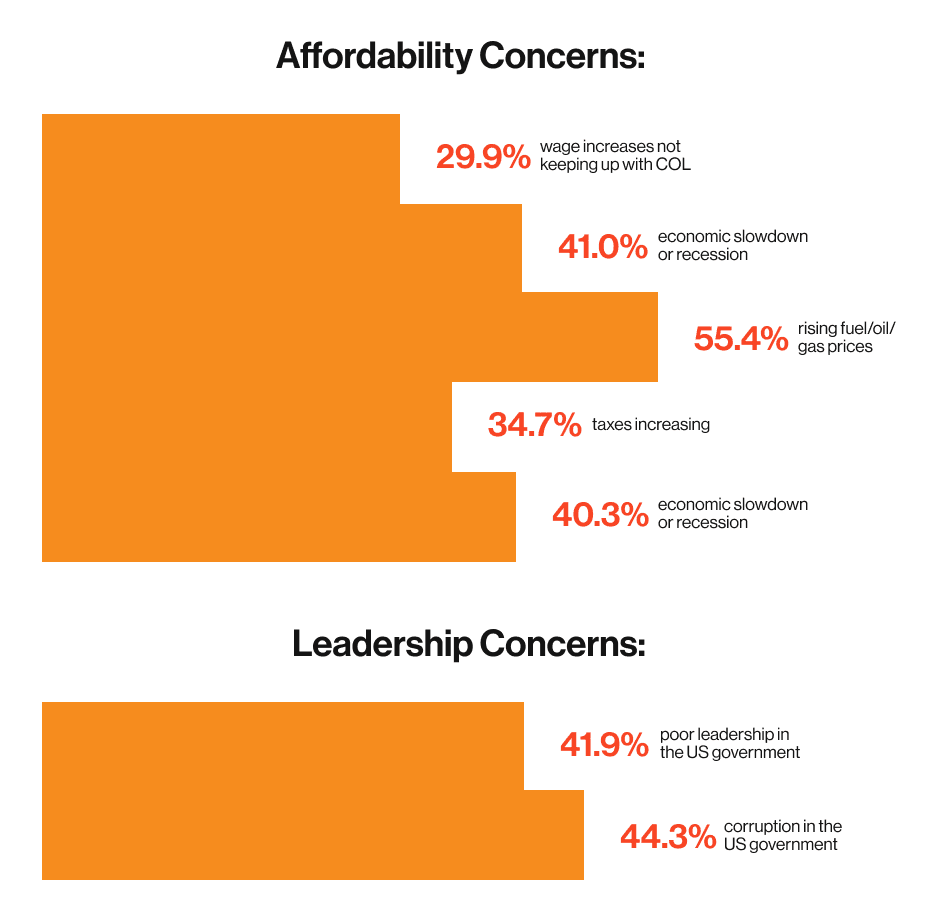
Given this litany of concerns, it’s no surprise to learn that pessimism is high. Nearly 37% of Americans now rate the US economy as poor, a 17.5% increase since March of this year.
Who Do Consumers Blame for Inflation?
Inflation has been a major element in flagging consumer confidence. For over 47% of consumers, blame requests squarely on the shoulders of President Trump. Focus on the White House as the reason for high prices rose more than 11% in the last three months alone. Just over 27% of consumers blame too much government spending, which increased nearly 10% in the same period. This chart tracks changes in consumer blame for inflation over the last few months:
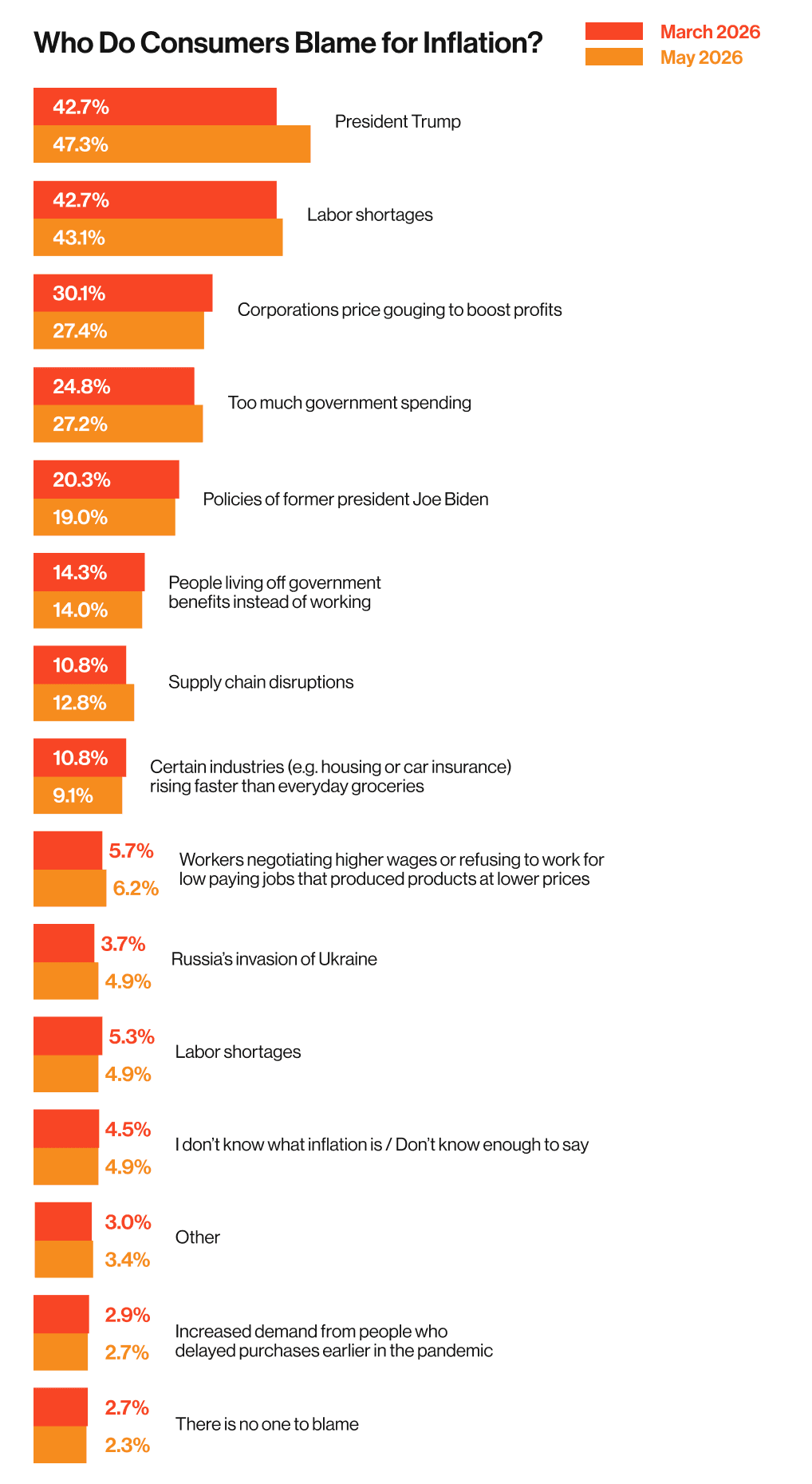
Another source of inflation blame that could be described as White House adjacent is tariffs: 43.2% of consumers cite trade policies as the reason for stubborn high prices. This number, however, is slightly lower than it was at the start of the year, when it peaked at over 44%.
There’s good news for brands here: Although over a quarter of consumers still blame corporate price gouging for inflation, that number is now lower than it was in March of this year. Attention has turned to the conflict in Iran, which is expensive for the government, consumers, and businesses alike. With the Strait of Hormuz blocked, 18% more consumers are now blaming supply chain disruptions for price hikes than they were back in March.
What’s Going on with Consumers’ Personal Finances?
At the start of the year, just under 50% felt the same about their personal finances as they did six months prior. Now, that number has dropped to 47%. The number of people who felt somewhat or significantly better off also fell, and there’s been a corresponding increase in the number of consumers who feel somewhat or significantly worse off.
Just over a quarter of the population expects to be somewhat or significantly better off in the next six months; now, 23.5% of consumers expect to be worse off, a 17.5% increase since March 2026.
What Can Brands Do About Negative Consumer Sentiment?
These numbers don’t paint a rosy picture; negative sentiment at this point is a long-term trend more than a blip on the radar. Resonate data and other sources over the last several years have reported that Americans are feeling increasingly bad about the economy and their finances. So what are your options if you’ve still got a business to run?
It is possible to drive revenue growth, even when consumers aren’t feeling great. But it requires you to take a deeper dive into their motivations, values, and behaviors, and that requires right data. You need predictive consumer intelligence, which provides you with an individual-level understanding of why consumers act and what they’ll do next.
Here are three strategies you can use to succeed and drive revenue in this climate by leveraging predictive consumer intelligence.
Strategy 1: Build media plans on motivation.
Targeting based on age, income, and gender tells brands where someone sits in a demographic, not why they’ll buy. Media spend consistently underperforms because the audience signal is weak. Predictive consumer intelligence gives media teams a sharper input at the planning stage, so every channel decision connects to a real consumer behavior rather than a demographic approximation.
Marketers who build their channel mix and creative strategy around consumer motivations, values, and intent signals spend their budgets against their next best customer, meaning people already moving toward a purchase now, not just people who superficially resemble past buyers. The result: higher conversion rates, lower cost per acquisition, and media budgets that actually work harder.
Strategy 2: Don’t let audience segments go stale.
Audience builds from six months ago don’t reflect today’s customers. Case in point: Look how much consumer sentiment has shifted in just three months. If you refresh segments infrequently, you’ll lose targeting precision as behaviors and values shift, which results in lost revenue.
The consumers in your acquisition segment may have already converted, churned, or changed what they care about. Segments built on continuously refreshed data keep pace with those shifts, so make sure you find a data partner who can deliver continuously updated intelligence. When the underlying consumer intelligence updates frequently, the audiences you build from it stay accurate, and the campaigns you run against them keep performing. The result: stronger ROAS, less wasted spend on the wrong people, and a more defensible revenue trajectory quarter over quarter.
Strategy 3: Understand why consumers are buying.
Two consumers who buy the same product in the same week may be motivated by entirely different things. One might buy because the price was right and they trust the brand, while another may have had a life event that made the category suddenly relevant. If your messaging speaks to the wrong motivation, it misses even when the targeting is right.
Understanding the “why” behind purchase behavior, through psychographic signals, intent data, and values-based attributes, gives marketers a clearer read on what message will connect and when. That’s where personalization stops being a buzzword and starts being a revenue lever. The result: higher engagement rates, stronger conversion at every stage of the funnel, and customer loyalty that leads to lifetime value.
Resonate Drives Growth
With Resonate, you get 15,000+ continuously refreshed attributes you can use to build a strong data layer to weather whatever the market throws at you. And there’s no need to rip out your entire tech stack and start again: You can enrich your own first-party data using our proprietary predictive consumer intelligence. This lets you close gaps and ensure your strategies are based on a whole-human picture of consumers.
Resonate also offers an agentic marketing platform called Cortex. It gives you automation combined with intelligence so you can move faster and smarter. This transforms every decision across the campaign lifecycle for better-aimed campaigns that result in higher ROI and better earning potential.
Ready to find your next best customer? Schedule a consultation with a data expert today.