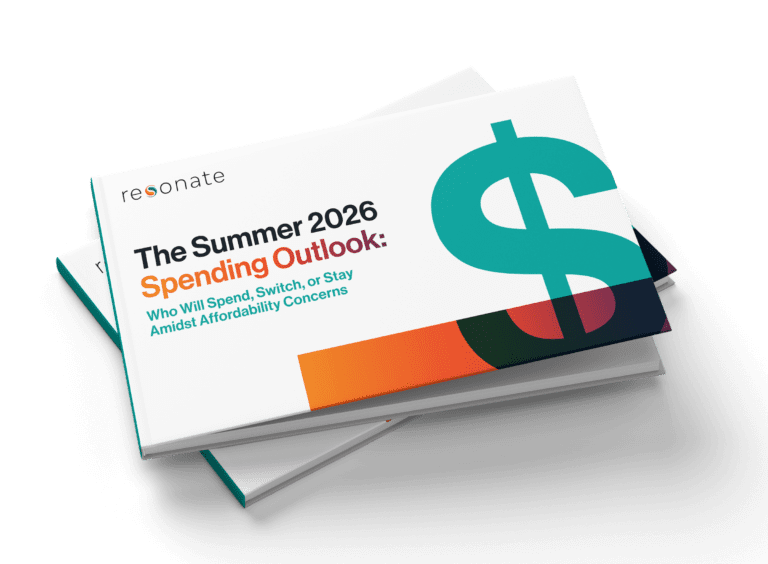


Resonate data shows consumer affordability concerns have jumped 30% in the last three months. Nearly half of consumers (48%) are worried about rising gas prices, and 38.4% are worried about the cost of healthcare.
Numbers like that tend to send marketers straight to the discount button. But in the first session of Resonate’s summer webinar series, “Predicting the Price-Pressured Customer,“ CMO Meredith Albertson and Manager of Customer Insights Amon Diop made the case that what surfaces as cost-consciousness belies deeper motivations around value. Affordability isn’t a verdict on your pricing. It’s a signal, and most brands are reading it wrong.
Before you cross your fingers and offer that next discount, here are the three takeaways from the session that every marketer should walk away with.
Takeaway 1: Cost Is a Constraint, Not a Reason
The default read on affordability data is that customers are telling you to lower your prices or lose them. But according to Albertson, the very real price sensitivity that we observe across the market is only the tip of the proverbial iceberg. “The problem for marketers isn’t that we’re misreading valid affordability fears,” she says. “The problem is that we tend to attribute every consumer motivation and decision to a single micro trend.”
When we treat price as the whole story, “Affordability concerns collapse into this single cost axis: too expensive versus cheap enough.” That binary might actually miss more customers than it attracts. It can lead to wasted spend on the wrong audiences, creative that misses the mark, and brand value that is undercut by discounts that customers never needed in the first place.
What we observe as affordability concern actually means someone is actively weighing value against a budget, and that calculation is shaped by status, life stage, personal history, and practicality just as much as by price. As Albertson put it, affordability “operates as a constraint, not a reason a customer buys or doesn’t buy.”
To illustrate this concept with real-world data, Amon Diop walked through three vacationer segments (theme park, concert and event, and beach and ocean travelers) who all share the same $4,000–$6,000 travel budget and all over-index on price as their top purchase driver. On a spreadsheet, they look identical. In reality, one is planning a family milestone trip, one is chasing a romantic getaway anchored around an event, and one is booking an escape from daily life. Same budget. Same price sensitivity. Three completely different reasons for buying.
The clearest proof came from a question Resonate asked all three segments directly: whether luxury amenities are worth paying more for while traveling. All three groups, despite over-indexing on price sensitivity, agreed. Diop’s read: “Cost-consciousness doesn’t mean cheap. It actually means deliberate. They’re looking for the brand that clearly earns the piece of the budget they’re willing to spend.”
Takeaway 2: Segment by Motivation, Not by How Price-Conscious Someone Looks
If cost alone can’t tell three audiences apart, something else has to. That something is motivation, and Diop showed exactly how much it changes the picture once you look past the shared price signal.
Take the same three vacationer segments and ask why they travel instead of what drives their purchase, and they stop looking anything alike. Theme park vacationers over-index on amusement and family time. Concert and event vacationers over-index on romantic getaways and trips with friends, with the event itself as the anchor. Beach and ocean vacationers are chasing an escape: no kids, no event, just a couple getting away from their life for a week.
That difference in motivation shows up again in what each group actually shops for in a hotel. Theme park travelers want a pool the kids will use and a loyalty program that stretches next year’s budget. Concert and event travelers want proximity to nightlife and frictionless tech: mobile check-in, keyless entry, fast Wi-Fi. Beach and ocean travelers want spa services and privacy, even though they’ve told you they’re cost-conscious. As Diop described it, “This is a self-declared cost-conscious traveler who is over-indexing on a paid premium service. That’s not a contradiction. That’s how value works.”
Even when two segments share a motivation, the messaging still has to diverge. Both theme park and concert-and-event travelers score high on wanting to check off a bucket-list experience, but Diop noted the fuller motivation profile changes what that means for each: one is “family bonding,” the other is “unforgettable moments with friends.” Two segments sharing a data point still need two different creative approaches.
“For a cost-conscious consumer, price is the frame they evaluate through,” explains Diop. “But the value is determined by what’s inside the frame.” Same frame, three different pictures. Message to what’s inside it, and you’re speaking directly to what each customer is protecting in their budget.
Takeaway 3: Build Toward Your Next-Best Customer, Not Just Existing Lookalikes
The first two takeaways change how you talk to the customers you already have. The third changes how you find new ones.
Diop pointed out that, while first-party data is essential, there’s a ceiling on its value. “Nearly all of [first-party data] is a record of the past. It tells you what somebody did, not why they did it and not what they’re about to do.” Backward-looking data tells you that a customer bought from you twice, then disappeared. It won’t tell you if they left over price, a life change, or a better pitch from a competitor. This kind of data “flattens people into two buckets because two buckets is all it shows.”
That limitation compounds when brands try to grow. A first-party file can only describe the people already in it, so scaling usually means building a demographic lookalike: same age, same income, same zip code. But people who look very similar on paper can want very different things.
Diop’s alternative is what Resonate calls a next-best customer: an audience found by matching on motivation instead of demographics. Diop broke the approach into three layers stacked on top of a brand’s existing first-party data:
- Intent — Who’s actually in market right now, not just who bought 18 months ago
- Motivation — The psychographic driver behind the intent
- Next-best customer — People who share your best customers’ motivations, even if they don’t resemble them on paper
As Diop describes, “A lookalike finds people who like their customers, while a next-best customer approach finds people who want what their customers want.”
It’s also not a replacement for the segmentation structures brands already run. One attendee asked whether motivation-based segmentation replaces a loyalty program built on purchase frequency and spend tier. Diop’s answer: it sits on top. Frequency and spend show the value of the relationship, but “what they’re not telling you is why someone is in the tier that they’re in or what would move them up.”
And because motivation isn’t fixed, this only works as a living layer rather than a one-time model. Resonate refreshes its intent and motivation data nightly, pulling from both survey responses and real-time behavioral signals, specifically so a shift in someone’s life stage or intent doesn’t sit stale in a profile for months. Diop frames this as the “shift from reacting to a price signal after the fact to anticipating what and why someone’s going to buy before they’ve told you.”
What This Means for the Rest of the Year
Albertson closed the session by tying the three takeaways to outcomes brands actually track:
- Lower acquisition costs because motivation-based targeting means less wasted spend on the wrong audience.
- Higher conversion rates because messaging matches what customers really value.
- Easier growth and retention because next-best customer targeting extends reach without diluting relevance.
None of this argues that affordability concerns aren’t real. Resonate’s own data shows they’re rising fast. The argument is about what to do once you see them: not react with a discount, but dig into what’s actually being protected in the budget.
You can watch the full webinar on-demand here. If you’re interested in learning more about reaching beyond surface-level signals and connecting with the values and motivations that shape them, schedule some time with our data experts for a chat.
The Resonate Summer Series continues on August 5, August 12, and August 19. Sign up for the whole series here.