


As brands work on summer and fall marketing campaigns and prepare themselves for the winter holiday season, one big question is on everyone’s minds: Will consumers keep spending money?
The short answer is yes, consumers are still spending, and they’ll keep doing so. That hasn’t changed. What has changed is where the money is going.
It’s no secret households are showing signs of strain. Consumer prices rose 4.2% in May, the first time they’ve risen above 4% in three years. Resonate data shows nearly a quarter of consumers report spending more money today than they were six months ago. This number was under 20% back in March. And as costs rise, people are also finding themselves less able to save: More than 35% of Americans now say they’re setting aside less than they were six months ago.
How Has Consumer Spending Changed in 2026?
With prices stubbornly high, consumers have shifted their spending habits to focus more narrowly on essentials, mixing in fewer “wants” than they did just a few months ago. Groceries, for instance, is still the top spending category, but it’s eating up a larger portion of the budget. As of May 2026, 41.9% of consumers plan to spend more on food in the next six months. This is an 11% increase in just three months, and, as testament to how high grocery prices have risen, it’s the first time this sub-category crossed the 40% threshold since Resonate began collecting data on this topic. The second-biggest spending category is utilities and energy bills; 29.3% of consumers anticipate spending more in this category, an increase of nearly 12% since March.
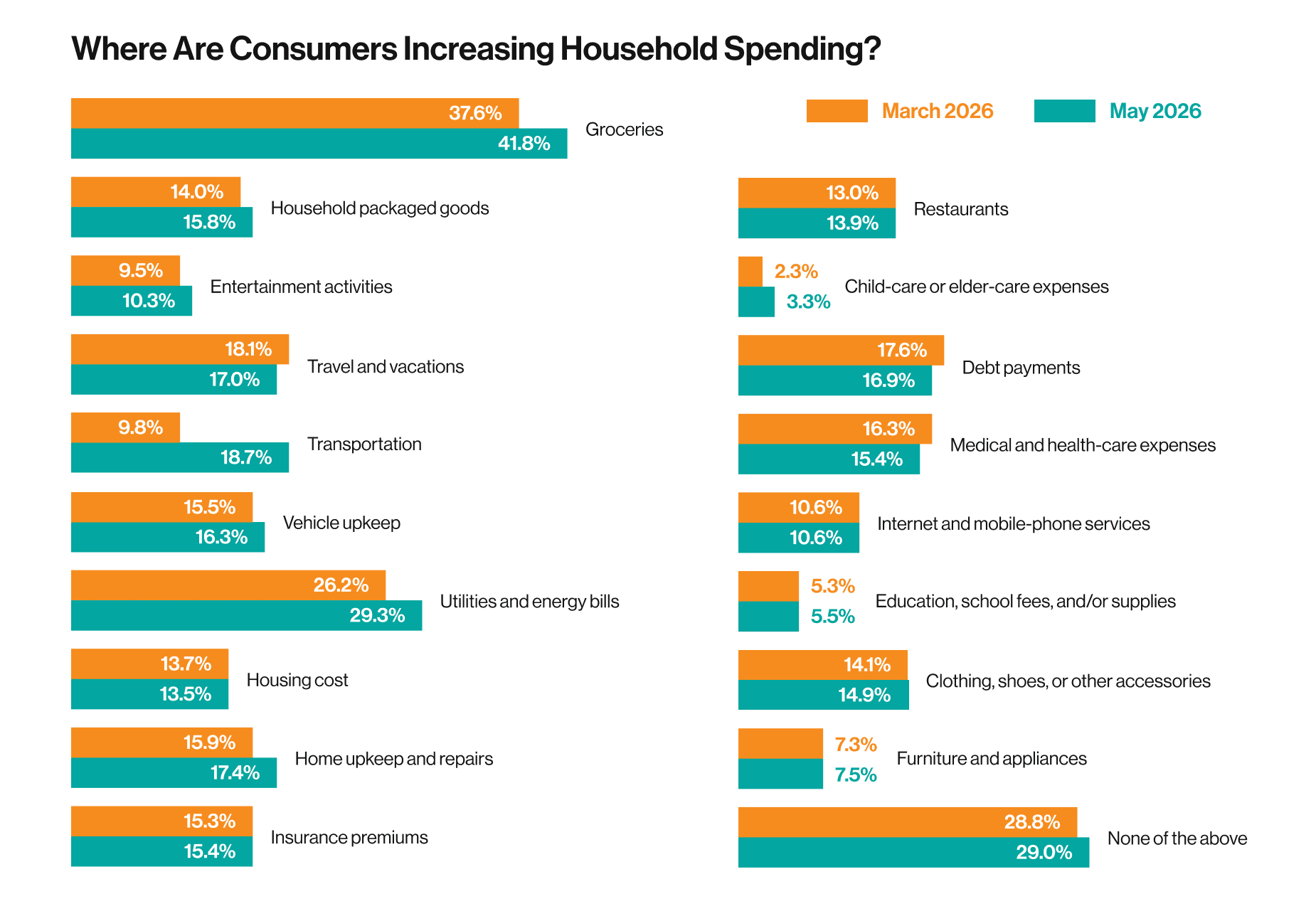
As the chart above shows, more money is going towards things Americans have no choice but to spend on, while less is going towards discretionary purchases like vacations and takeout.
For example, there has been a 91% increase in the number of consumers who plan to spend more on transportation, a category which includes fuel costs. This is the biggest leap over the last three months, Back in March 2026, just under 10% of consumers planned to spend more on getting themselves around. As of May, that number was over 18%.
Where does this leave brands?
Depending on your industry vertical, there may be a host of specific spending sensitivities driving purchasing decisions among your likeliest customers. Let’s take a deep dive into a few areas where there have been significant changes in consumer spending.
The Stock Market & Retirement Funds
Recent stock market volatility is impacting investment and retirement allocation. In the last three months, there’s been a 10% increase in the number of people who are delaying retirement and a nearly 18% increase in the number of consumers who are postponing new investment decisions.
Luxury Spending
More than 30% of Americans are now opting for lower-price generic or alternative brands as opposed to premium ones, a 10% increase in the last three months. And now, just under a quarter of consumers say their luxury spending behavior won’t change. This was just over a quarter back in March, which meaning we’re seeing a dip in consumer confidence that is leading to caution.
One interesting callout: More people (15.9%) are avoiding buying alcohol and spirits entirely. This action is more popular than other saving-coded behaviors such as switching to American-made brands to offset tariff hikes.
Electronics and Technology
Consumers are changing their behavior around electronics and technology purchasing, as well. Back in March, just over 33% said they weren’t altering their plans. As of May, that number had dropped to 29.9%. As a result, we’ve seen big increases in bargain hunting, especially buying products early (before demand forces prices up) and shopping exclusively during sales events or promotional periods.
Travel or Leisure Plans
Travel is seeing a similar flurry of behaviors. Here again, fewer consumers are going forward with their original plans regardless of cost. There’s been a nearly 25% increase in the number of people who are canceling or postponing cruises or long-distance vacations, and just over 30% of consumers are now taking fewer trips overall, as opposed to 27% back in March.
Dining Out, Clothing, and Other Discretionary Spending
Dining out, taking vacations, and spending on entertainment like sports and movies are the top three most-canceled discretionary spending categories for consumers. Over 39% of consumers will reduce or eliminate dining out entirely, a number that has slowly been increasing over the past year as prices rise.
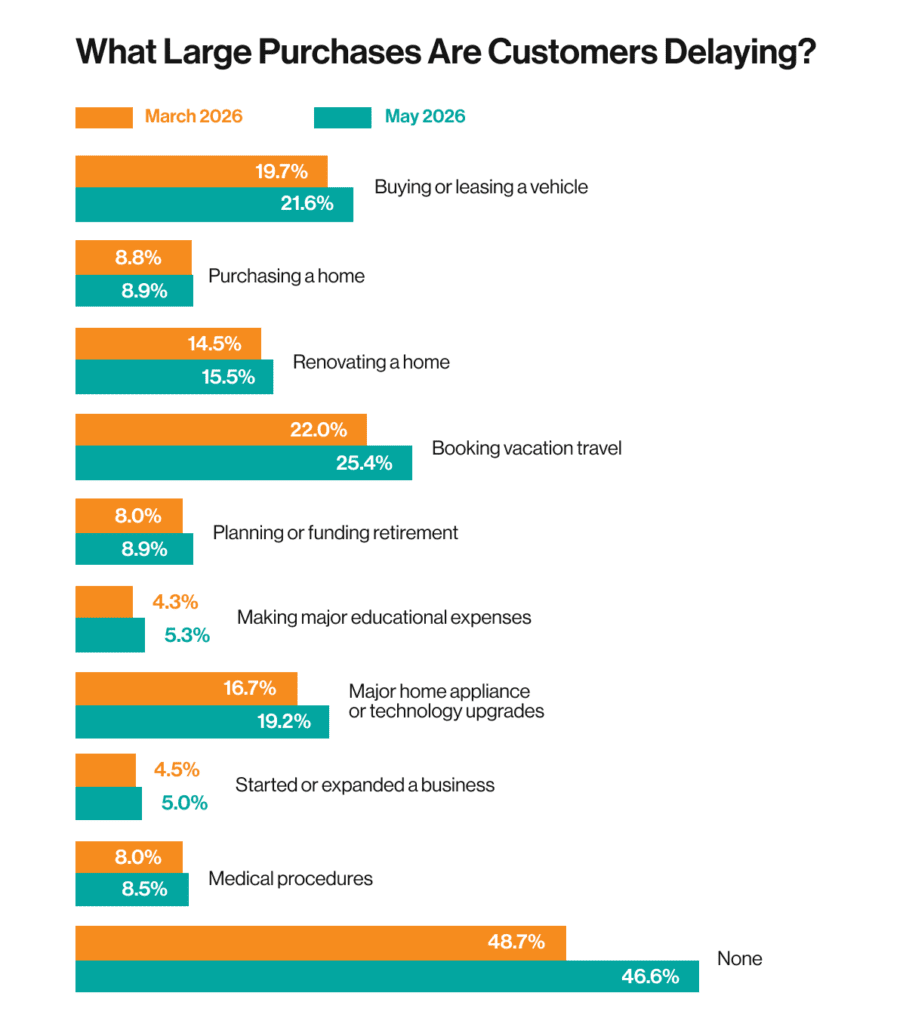
More than 27% will spend less or spend nothing on travel, the highest percentage since Resonate began collecting data on this subject. Another 18% of consumers say they’ll reduce spending on clothing or accessories if economic conditions continue to decline. Resonate’s data also offers insights into planned consumer behaviors surrounding big purchases, like new cars, appliances, or home renovations. The number of consumers who are full-steam ahead with their large purchases has dropped to 46%.
While this still represents nearly half of the population, it’s noteworthy that this percentage has been slowly going down since Fall 2025. It’s an important indicator of consumer buying trends overall because large purchases are often the last holdout during times of economic uncertainty. After all, these items are always relatively high-priced, so sticker shock isn’t typically as big a factor as things like overall necessity or long-term value. The slow erosion of this consumer base shows real cracks in long-reliable categories.
The three big purchases categories that are hardest hit include auto, travel, and appliances. More consumers are planning to postpone new-vehicle purchases, vacations, and home appliance or technology upgrades in the coming months.
3 Strategies to Drive Revenue Growth Throughout 2026
This data is crucial to business strategy and growth-marketing planning. The shifts are small, subtle, and happening quickly. Now more than ever, a marketing plan based on what was going on earlier in the year is unlikely to resonate with consumers now and will probably miss the mark, resulting in wasted spend and plateauing revenue.
But it’s also important to know how to act on the data once you have it, so your brand can still drive growth even if conditions are less than optimal. Here are three strategies every business should implement.
Strategy 1: Make sure your data layer keeps up with evolving consumers.
For many brands and agencies, first-party alone isn’t enough for an up-to-date, individual-level understanding of the ideal next customer. Such data is excellent for understanding past purchasing behaviors or demographics, but it can’t make accurate predictions about what additional products or services their customers are in-market for right now. It also can’t apply that more nuanced understanding to reach as-yet-unknown customers.
Revenue growth in a highly competitive market like this requires a new kind of data that goes beyond these limitations: predictive consumer intelligence. Predictive consumer intelligence gives you the ability to know every consumer as a unique individual on the level of personal values, motivations, life-context, and intent signals. These attributes enrich what you already know from first-person data and make it possible to predict what customers will do next, before they do it.
Building a data layer on predictive consumer intelligence positions you to acquire better customers, keep them longer, and grow their value over time.
Strategy 2: Incorporate data-driven personalization into your strategy.
Personalization works best when it reflects who consumers are right now, not who they were six months ago. Given the rapid fluctuations in consumer spending you can see in the charts above, your strategy may already be out of step with your customers’ lives.
Brands that build their personalization strategy on deep, continuously refreshed consumer attributes, including values, intent, preferences, and psychographics, can go well beyond demographic targeting to reach people based on what’s motivating their decisions at this moment.
That depth makes it possible to deliver relevant messages and experiences across every channel and touchpoint, from digital ads and email to website experiences that adapt in real time, whether the visitor is known or anonymous. The results include higher engagement, stronger conversion, and marketing spend that produces measurable returns.
Strategy 3: Focus on retention more than acquisition.
As spending tightens, competition for a smaller number of consumers is increasing in nearly every industry. Rather than spending more and more on acquiring new customers, make sure you have a solid plan in place for keeping your current best customers.
Predictive consumer intelligence gives you the ability to see who is likely to disengage early, so retention efforts reach the right customers at the right moment before the relationship is lost. By combining your first-party data with continuously refreshed behavioral signals, churn models surface the specific individuals at risk and tell you why. This makes your outreach relevant rather than reactive.
That precision means retention spend goes toward customers who are really at risk, with messages and offers built around what’s driving their behavior right now, so you don’t show up too late.
Partner with Resonate to Drive Growth
Resonate’s predictive consumer intelligence gives you individual-level visibility into intent, values, and behavioral signals across the full US adult population, continuously refreshed so your strategies reflect today’s market, not a static snapshot of the past. That means you can identify your next-best customers before a competitor does, intervene with at-risk customers before they leave, and build every campaign on a foundation that moves with your business.
See how leading brands use Resonate to grow with confidence. Schedule a consultation with a data expert today.