


It’s Thursday afternoon. You have a campaign brief due Monday and a stakeholder meeting tomorrow.
The brief is half-finished; you know who the audience is, roughly. What you don’t know is how to get from this document to a live campaign by next week without burning three days stitching together research, segmentation, and activation across tools that were never designed to talk to each other.
For most marketing teams, this is a familiar scenario. And it’s a challenge that repeats itself every campaign.
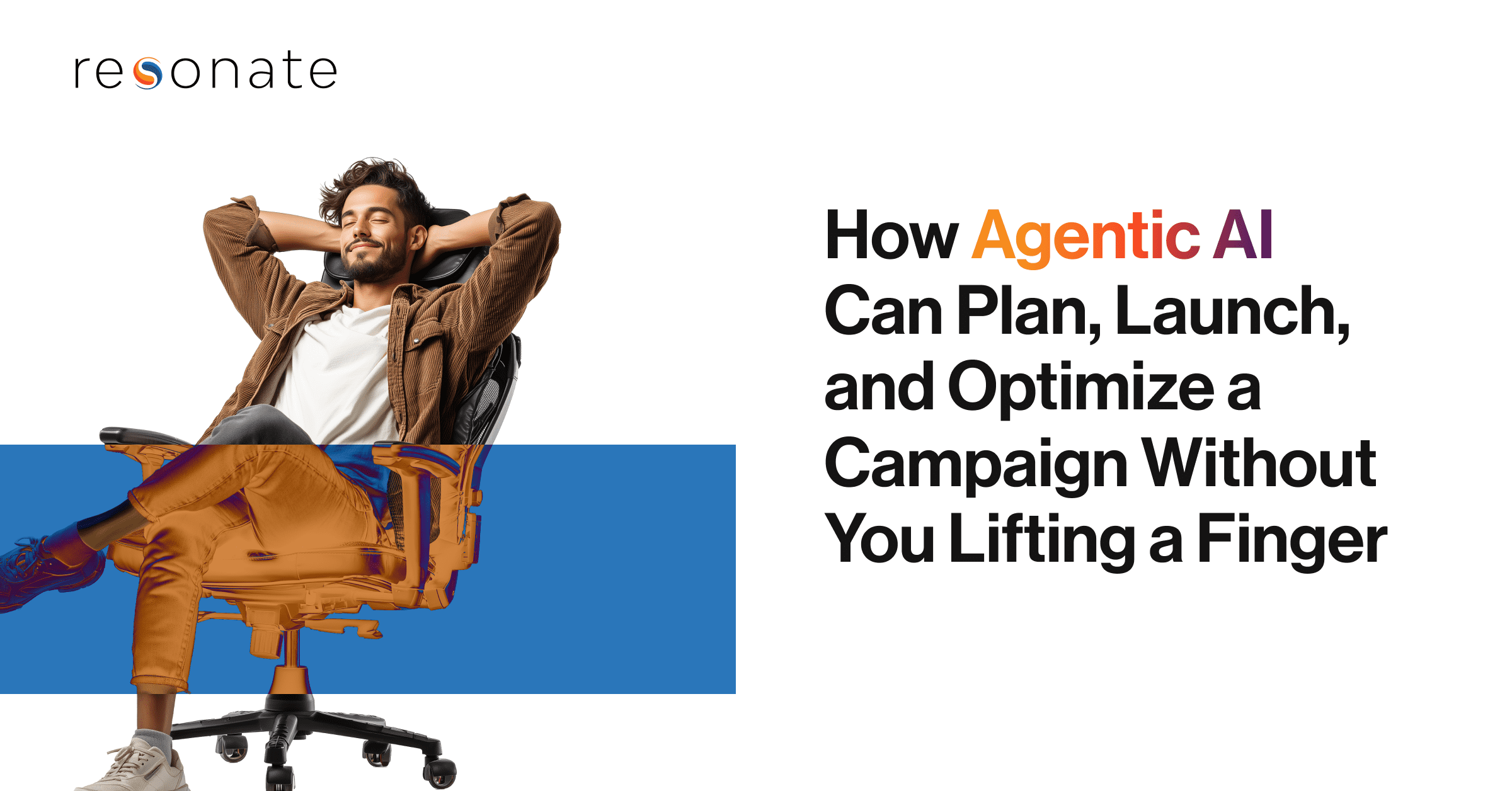
Agentic AI is a specific and meaningful solution to this challenge. It can read the brief, build the audiences, and push them to your media platforms with rationale grounded in real, individual-level intelligence at every step.
So, what does agentic AI actually look like in practice?
What “Agentic” Actually Means for a Campaign Team
You’ve probably heard the term “agentic AI” mentioned at industry events, followed by a long, often vague description. In fact, it has accumulated a lot of vendor definitions over its short lifespan.
Here’s a plain-language, to-the-point version: “agentic” means the AI handles the decision chain, not just a single stage of the process.
A conventional, non-agentic AI tool answers one question at a time. For instance, you ask for audience ideas, and it provides them for you. You still do all the connective work, from collecting the outputs to validating them against your data to building the audience in your platform and pushing them to media.
An agentic system operates differently. It takes a brief, extracts the objective, identifies the best-fit audiences from real consumer data, builds and ranks them, and prepares them for activation. The human approves, refines, and launches. The AI handles the steps in between.
5 Stages of Success: How Agentic AI Changes the Workflow
Here is what changes at each stage of a standard campaign lifecycle when agentic AI is in the workflow.
Stage 1: Insight and Strategy
Instead of having a research analyst pull reports from multiple platforms and spend days synthesizing data from different sources, the agentic AI reads the brief and surfaces the most relevant consumer motivations, values, and intent signals in the time it takes to grab a cup of coffee. The analyst’s time goes to interpretation, not excavation, and their recommendations are passed onto the team by the end of the day at the latest.
Stage 2: Audience Segmentation
Without agentic, the process of segmenting audiences requires manual builds across disconnected tools. This can involve hours of taxonomy work, only to result in segments that describe who someone was three months ago, not who they are today. With agentic AI, the agent will build and rank audience segments for you, based on the campaign objective. Each segment comes with a rationale tied to the underlying consumer data, not a black-box recommendation. You’ll go from brief to campaign-ready audiences in minutes, with no IT lift.
Stage 3: Creative and Messaging Strategy
Skip the messaging frameworks built on instinct or outdated data. Agentic AI surfaces the values, motivations, and communication preferences of each audience segment, providing your team with the insights they need to engage consumers. Your creative team will be working with information like “this audience prioritizes financial security and community trust, responds to direct language, and is skeptical of aspirational brand messaging.” They’ll still handle the creative; they’ll just be doing so with better intelligence rooted in what an audience actually cares about now.
Stage 4: Campaign Activation
Without agentic, activation teams have to manually export, format, and upload campaigns to each media platform. Disconnected tools require different logins, different file formats, and a working knowledge of each platform’s audience builder. Agentic AI makes campaign activation easy. With one click, the campaign is pushed to your DSP, SSP, or social platforms.
Stage 5: Optimization
While a post-campaign rundown might still be useful, you won’t be relegated to only analyzing what happened after the campaign. Agentic AI’s ongoing signal processing will note surface shifts in audience behavior and motivation almost as they’re happening. You can make data-backed decisions grounded in understanding, not just after-the-fact performance metrics.
The question for most campaign teams is not whether agentic AI will change how they work. It is whether they will be the ones directing that change or adapting to it after the fact.
When the workflow runs itself, the team’s judgment becomes the highest-value thing in the room. That is not a diminishment. It is a reorientation toward the work that only humans can do.
What the Data Underneath Makes Possible
Generative AI produces audience ideas. Agentic AI grounded in proprietary consumer data generates audiences that perform. The distinction is the intelligence layer, not the automation layer.
Most AI tools in marketing build recommendations from aggregated web data, behavioral proxies, or demographic assumptions. They can describe what a segment looks like in aggregate. They cannot tell you what is driving the individual decision.
Predictive consumer intelligence (PCI) can tell you the why. This is possible for three reasons:
- Recency — PCI is continuously refreshed for the most up-to-date view of your customer right now.
- Richness — With 15,000+ individual-level customer attributes that can be used to enrich first-party data or on their own to build audiences, PCI gives you a depth of understanding that reaches beyond zip codes and purchase history.
- Relevance — By aligning to values, motivations, and life-stage indicators, PCI makes it possible to deliver true personalization in your creative, delivered to the channels where your customers make purchase decisions. It’s always the right message in the right places.
These features of PCI make it possible to know every consumer as a unique individual and predict what they’ll do next, before they do it. In a time when understanding a consumer is crucial to driving success, predictive consumer intelligence is a must for brands that want to grow.
That difference is practical, not philosophical. A segment built on behavioral signals alone can tell you that someone visited a financial services website twice last month. A segment built on motivation data tells you that person prioritizes financial security over growth, trusts institutions with a track record over challengers, and is currently in an active decision window. One of those segments performs. The other one fills an impression.
Resonate Cortex, Resonate’s agentic marketing platform draws on 250M+ individual-level consumer profiles, 15,000+ motivation, values, and intent attributes, and 30 billion daily signals. That data layer is what separates an agentic system that automates workflow from one that improves outcomes. Using PCI and AI technology, Cortex compresses what used to be an hours-long understanding, segmentation, and activation workflow into minutes.
Thursday Afternoon Looks Different Now
The brief goes in. The audiences come back, ranked, with rationale, grounded in individual-level consumer data, ready to activate. The team approves them, refines what they want to refine, and pushes to media.
What used to take three days happens in minutes. The meeting tomorrow is no longer about where the audiences are. It is about what to do with them.
That is what agentic AI looks like inside a campaign workflow: It makes the humans’ judgment the most important part of the whole process and gives them room to think and to be creative.
Ready to See the Resonate Difference?
Ready to find out how agentic AI will make a difference for your team and campaigns? Request a Resonate Cortex demo today.