

Despite rising gas prices, global unrest, relentless inflation, and a high cost of living, consumer appetite for travel has remained surprisingly resilient. True, increased costs are sidelining some would-be vacationers, but others have simply made adjustments to their budgets or plans and packed their suitcases anyway.
At this point, many people have already hit “book” on their summer plans, so it’s time to look ahead to the travel forecast for Fall 2026. Even though autumn is still a few months away, what’s going on now economically, globally, and financially for consumers will affect their travel plans in the future.
With fuel prices high, money tight, and the school season starting again by September, it’s inevitable that many consumers will choose to stay home rather than splurge on a trip. Indeed, Resonate’s data shows 42.5% of people have decided not to go anywhere this fall. That leaves the 57.5% who are currently in-market for a trip or who are still on the fence about their travel plans and therefore persuadable. Competition for this segment, especially those who fall into the luxury category, is fierce. It’s crucial for travel brands to have strategies in place to successfully target the right consumers and for businesses to have data that looks ahead to what travelers are going to do before they do it.
That kind of data is called predictive consumer intelligence, and it enables brands to understand the crucial why behind consumer behavior. In this blog, you’ll learn more about predictive consumer intelligence, get a look at some of the insights Resonate offers on travelers and their behavior over the next few months, and discover how to use predictive consumer intelligence to build agile, engaging campaigns that can be optimized in accordance with consumer behavior.
What Can Brands Expect from Consumer Travel in Fall 2026?
Some consumers have seen the higher prices, shrugged their shoulders, and decided that instead of a staycation, they’d simple budget more for globetrotting.
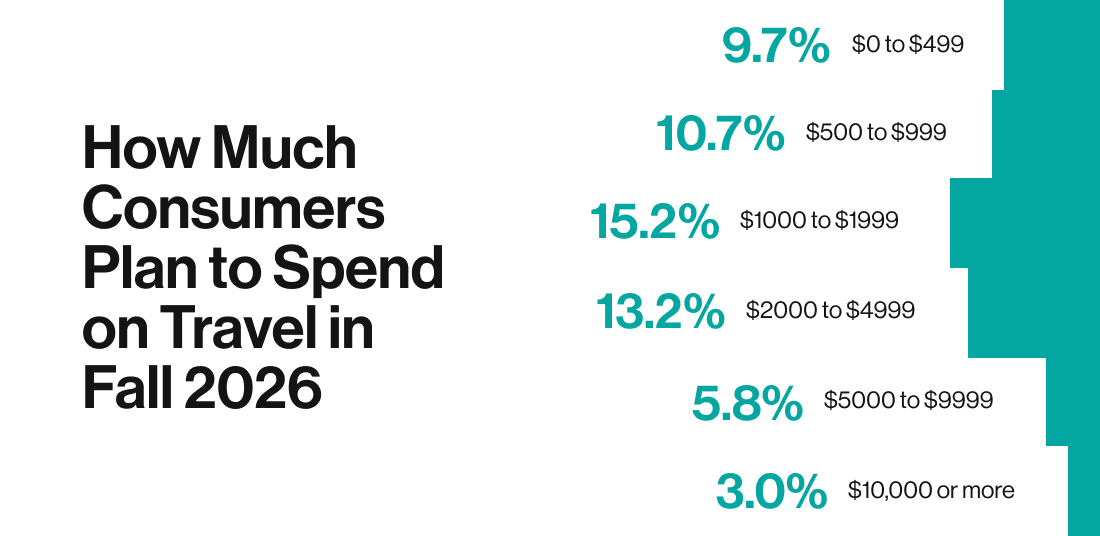
Indeed, this behavior increased over the last year. In Fall 2025, 18.7% of consumers planned to spend $2,000 or more on their trips. This year, it’s 22%, a nearly 18% increase. There’s also been an uptick in the number of consumers who are willing to spend between $1,000 and $1,999: Over the last year, that segment has grown nearly 12%.
Here’s a breakdown of the spending categories of consumers for Fall 2026 using Resonate’s predictive consumer intelligence:
The Takeaway for Marketers
Fall travel represents a genuine mid-to-premium spending opportunity, with the majority of those intending to travel concentrated in the middle and upper tiers rather than the budget end. Marketers should resist the urge to lead with low-cost or budget messaging, as this audience is more likely to be shopping for value and experience than for the cheapest option available. Brands that position around quality, memorable experiences, and worth-the-spend storytelling are better aligned with genuine consumer intent signals.
Now, let’s turn to what travelers are actually doing in response to economic volatility:
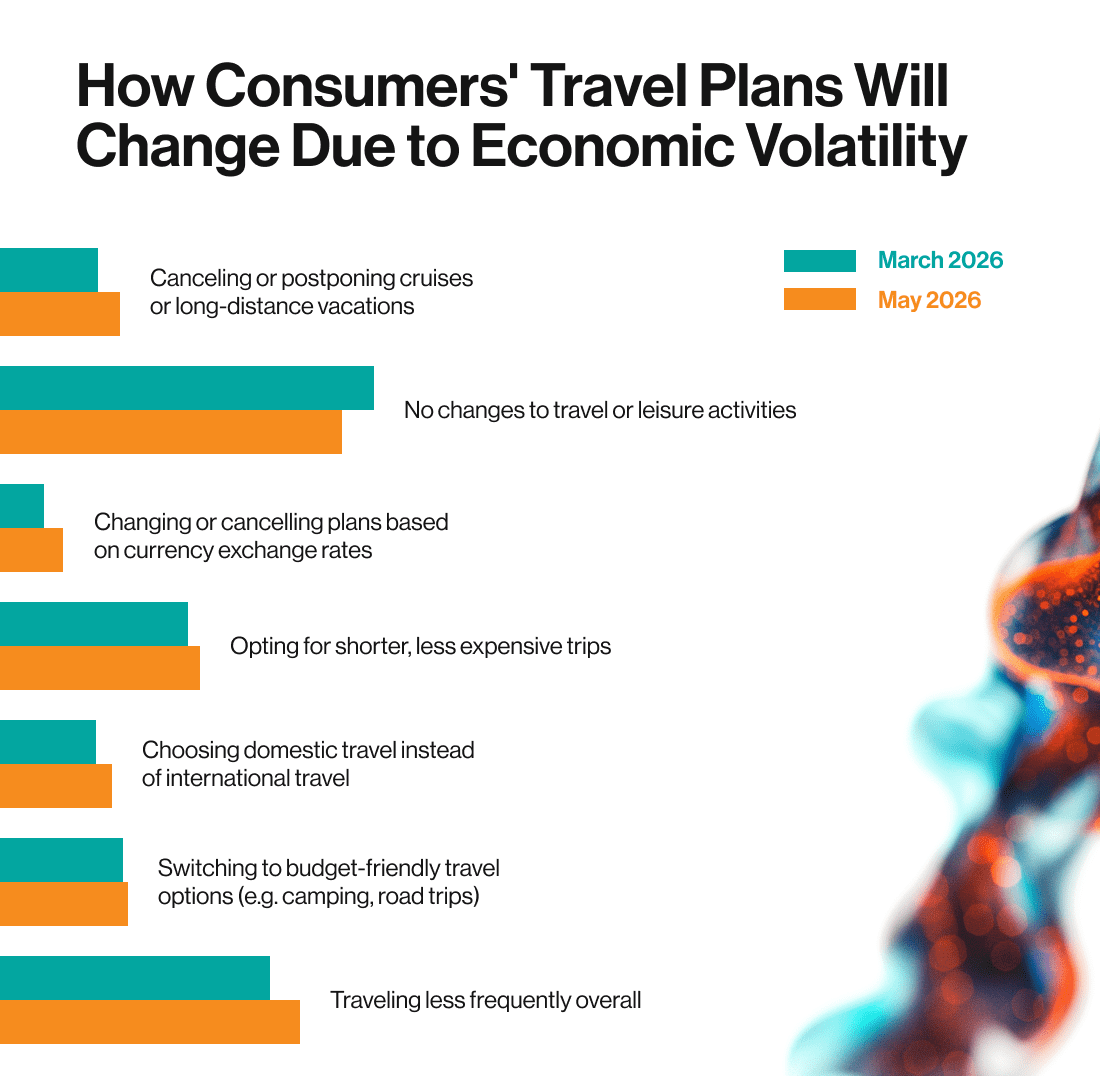
Resonate data reveals that, while travel is resilient, price concerns are causing some to be more selective about the kinds of travel experiences they seek out. A fair percentage of them are spending more, but between March and May of this year, there’s also been a nearly 17% increase in the number of consumers who are choosing domestic travel over international locations. In the same time period, there’s been a 40% increase in the number of consumers who are changing their travel plans based on currency exchange rates.
Perhaps most tellingly, a significant number of consumers – nearly one-third – are now choosing to travel less frequently overall. This number increased over 10% from the period between March and May 2026.
The Takeaway for Marketers
Travelers aren’t abandoning their plans; they’re reshaping them. The move toward domestic, shorter, and more budget-conscious trips is a signal to marketers that reach and relevance now matter more than aspirational messaging. Consumers are making practical tradeoffs, and brands need to meet them where they are, as opposed to trying to sell a once-in-a-lifetime dream vacation. This is a moment to lean into flexibility, proximity, and value framing, because the window between when a consumer changes their mind and when they book an alternative is narrow.
How Predictive Consumer Intelligence Supports Stronger Travel Marketing
Predictive consumer intelligence gives travel brands something traditional data simply can’t: the ability to reach the right traveler at the right moment with messaging built around what they actually care about. This allows marketers to:
- Reach travelers during their decision-making window. Once travelers decide to take a vacation, final plans and bookings are made quickly. Demographic or past-purchase data can’t refresh quickly enough to keep pace. Intent signals help you engage the traveler before they’ve committed to a competitor.
- Drive customer acquisition and retention at all price points. High-end, luxury travelers only make up 2.5% of the market, yet they tend to be the primary target of campaigns. Predictive intelligence allows you to identify previously unknown travelers at all price points, so you can market specifically to them, lower acquisition costs with precise messaging and higher conversion rates, and increase deal volume by expanding to a larger pool of customers.
- Adapt to the changing lives of travelers. When it’s time to book a trip, life context matters. The needs of your customers will change over the course of their lives, but past-purchase data means you’re treating them like the traveler they used to be instead of the one they are now. Predictive intelligence alerts you to life-change signals, so you can provide the right experience for here and now.
To learn more about how Travel and Hospitality marketers can get the most out of predictive consumer intelligence, you can download the Growth Itinerary, a free guide on addressing your key challenges.
Now, let’s take a look at how predictive consumer intelligence works in the real world.
How a Major Cruise Line Used PCI to Expand Its Addressable Market
For years, a leading cruise brand had built its marketing strategy around a familiar playbook: target past cruisers, reach households that looked like past cruisers, and invest heavily in the premium segment where margins were strongest.
It worked, until it didn’t. Rising acquisition costs, a shrinking pool of repeat bookers, and increasing competition for the same high-value audiences put a hard ceiling on the strategy.
Rather than continuing to fish in an increasingly crowded luxury pond, the team used predictive consumer intelligence to identify a largely untapped segment: mid-tier travelers who had never cruised before but showed strong behavioral and values-based signals that they were ready to.
Predictive consumer intelligence surfaced more than demographics; it uncovered what mattered most to these travelers. This included things like family experiences, value for money, and once-in-a-lifetime moments. It also revealed which channels they were using to research travel at that exact moment. The brand built messaging around those motivations and deployed it precisely when those consumers were in an active planning window.
The results reframed how the brand thought about its market. Acquisition costs for the new segment came in significantly below what they’d been paying to reach luxury repeat-bookers, and conversion rates improved by reaching travelers whose values and timing were closely aligned to offerings.
But the longer-term impact was the more significant story: a meaningful portion of those first-time cruisers went on to book again — and to upgrade. By reaching them at the right life stage and delivering an experience that matched what predictive consumer intelligence told the brand they were really looking for, the cruise line didn’t just add a booking. It added a customer relationship with a multi-year revenue arc that their old strategy would have missed entirely.
Ready to See the Resonate Difference?
Resonate’s predictive consumer intelligence gives brands an individual-level understanding of traveler motivations, intent signals, and purchase behavior, continuously updated so your targeting reflects who your audience is right now, not six months ago. Whether you’re trying to acquire new customers, retain high-value travelers, or prove performance to stakeholders, Resonate lets you act with precision.
Check out the full Growth Itinerary for Travel Marketers, and schedule a consultation today and see what your audience looks like when the data actually reflects them.