

The fundraising director had a list of 1.8 million contacts and a model that had been working fine for years. The donors were registered with the right party and had given before. The logic was sound.
But recently, donations had started to flatten out. And when the team went back through the results, they noticed some patterns emerging. Donors who had faithfully given for years had gone dark. A segment that wasn’t receiving any special marketing had performed above expectations. What was going on?
The answer had to do with the model the director was relying on. It had been answering the question, “Who gave before?” Instead, it needed to answer the question, “Who is ready to give now, and why?”
The Problem with Assumption-Based Donor Programs
Most donor acquisition and reactivation strategies in the political world are built on the same foundation: past donation behavior, party registration, and demographic similarity. While this framework isn’t wrong, it is incomplete, and at some point, campaigns using this model tend to hit a wall, like our example fundraising director.
This kind of model can’t account for motivation shifts. Someone who donated reliably two cycles ago may have changed their priorities or their relationship with the cause or candidate. Meanwhile, a person who has never donated before but holds deeply aligned values with your organization could be the readiest prospect, but because they’re on a cold list, they’re being unintentionally ignored.
How a Next Best Donor Model Solves the Fundraising Problem
No matter how detailed your demographic profile is, it can’t explain when or why people will act. To separate donors who give from those who won’t, you need their motivations, values, and intent. Many political organizations don’t have this information, so they keep optimizing the same backward-looking model and wind up getting incrementally better at targeting people who already gave instead of finding more people who are about to.
This model actually has a name: It’s called the look-alike model. It finds people who resemble your best donors based on shared traits or past behaviors. It’s useful for expanding reach, and it’s been the standard for years.
But campaigns that rely solely on look-alike models tend to hit donation plateaus for two common reasons. First, behavior and demos don’t always correspond neatly to future intent. This means past donors can become ex-donors and the values that once informed behaviors can change.
The second headwind facing look-alike models is the velocity of change across your potential donor base. Context — from world events, economic volatility, individual life events — shift constantly and swiftly. Donors also receive constant signals from sources like social media; the messages they see are just one tweak of the algorithm away from being completely different one day to the next. Look-alike data can’t refresh fast enough to capture these shifts.
This is where the next best donor model comes in. It predicts which specific individuals are most likely to give next based on continuously updated behavioral signals, not just their superficial resemblance to a previous donor. Every record in your database or across a national population gets scored on donation likelihood, giving you a ranked list. The highest-propensity donors sit at the top, while the people who are unlikely to give this time are suppressed.
As a result, instead of sending out messaging to your full list of donors and just hoping the right people respond, you’ll be talking to the people who are the likeliest to answer right now. You stop blind-firing into a database of two million contacts and start reaching the 200,000 who are in a giving window right now, instead of missing half of them simply because they’ve never given before or appear slightly different on paper than donors your familiar with.
Let’s see what this looks like in real life.
Real-Life Success Story: How New Blue Interactive Modernized Donor Acquisition and Reactivation
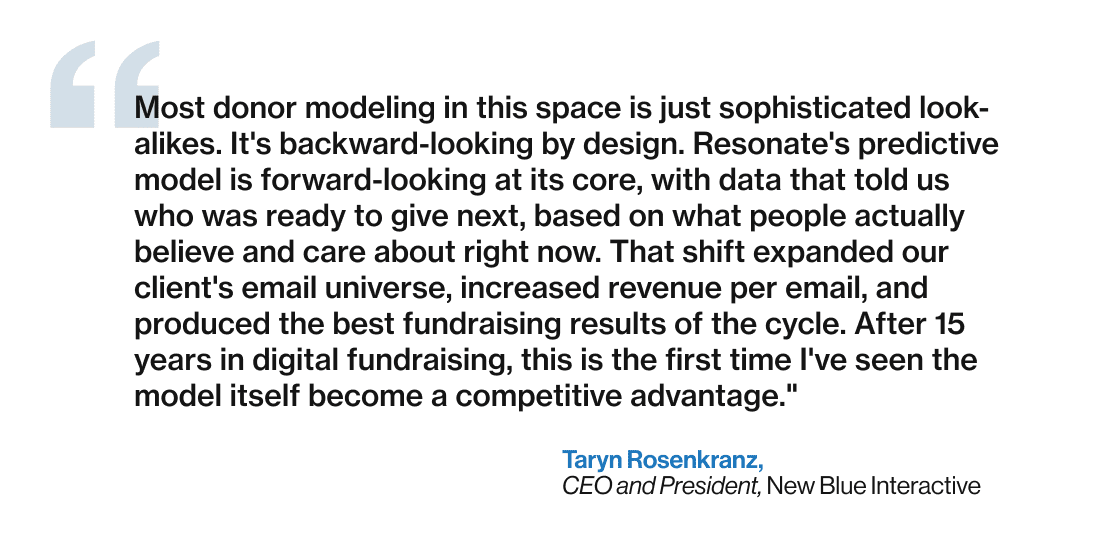
New Blue Interactive, a digital fundraising firm, faced a problem that most organizations in this space will recognize immediately. They had a large donor database, a reliable core of known givers, and a long tail of contacts they hadn’t been reaching effectively. Traditional list expansion and look-alike strategies weren’t giving them the precision to confidently identify who was most likely to donate next, and they needed to grow revenue without over-emailing their list or degrading deliverability.
They partnered with Resonate to build a next best donor model that scored their database on donation propensity, identifying who within their list was in an active giving window based on real-time behavioral outcomes rather than historical similarity alone.
The results: a 277% improvement in targeting precision, with no increase in unsubscribes. The model correctly predicted who was ready to give, not just who had given before. The client’s email-donor universe expanded by 68.9%, and the campaign produced the best fundraising results of the cycle.
And the best part: The models were delivered in five business days, with no data science or engineering work required on New Blue Interactive’s end. They simply provided the first-party data on their known donors. Resonate built the model, scored the list, and returned ranked records ready to activate across email, SMS, or digital media.
Transform Your Fundraising Efforts Today
A next best donor model changes what’s visible by predicting, from your existing data and the full digital population, which individuals are most likely to give next and why.
Ready to see who your next best donors are? Schedule a consultation with a Resonate data expert today.