


Every year, it’s the same: You’re given a mandate to grow revenue and exceed last year’s numbers. There are some clear opportunities; perhaps your media spend is inefficient, you’re missing conversion opportunities, or your pool of loyal customers is drying up.
To you and your team, the case for investment is obvious. For instance, let’s say you’re convinced the company needs a data-enrichment product, and you know that with one, you could:
- Reach the individuals most likely to convert and maximize spend
- Identify who is likely to churn and increase relevance to lift loyalty and lifetime value
- Go from signal to activation faster
Despite all the advantages of the missing piece you want to add, the boss comes back with bad news: Sorry, there’s no budget this year.
Sooner or later, we all bump up against budgetary restrictions that keep us from making necessary investments. Quite often, though, procurement is possible with a value-based approach that reaches beyond the narrow needs of a single function and ties additional spend to business-wide outcomes. This blog focuses on how to make a strong, business-first case when you hear the dreaded “no budget” brush off.
Value and Risk: How to Craft a Better Argument for More Budget
When it comes to budget, “nice to haves” get kicked down the road in favor of “must haves,” so it’s critical to frame your ask as a necessity that seizes measurable growth opportunities and assesses the business risks of doing nothing. This is the 360-degree view that business leaders take when allocating limited resources.
To best articulate value and illustrate potential risks of inaction, begin with a comparison between what you have now and what you’re asking for. When it comes to consumer intelligence, this means contrasting what is possible given your existing first-party data with what’s possible with third-party enrichment.
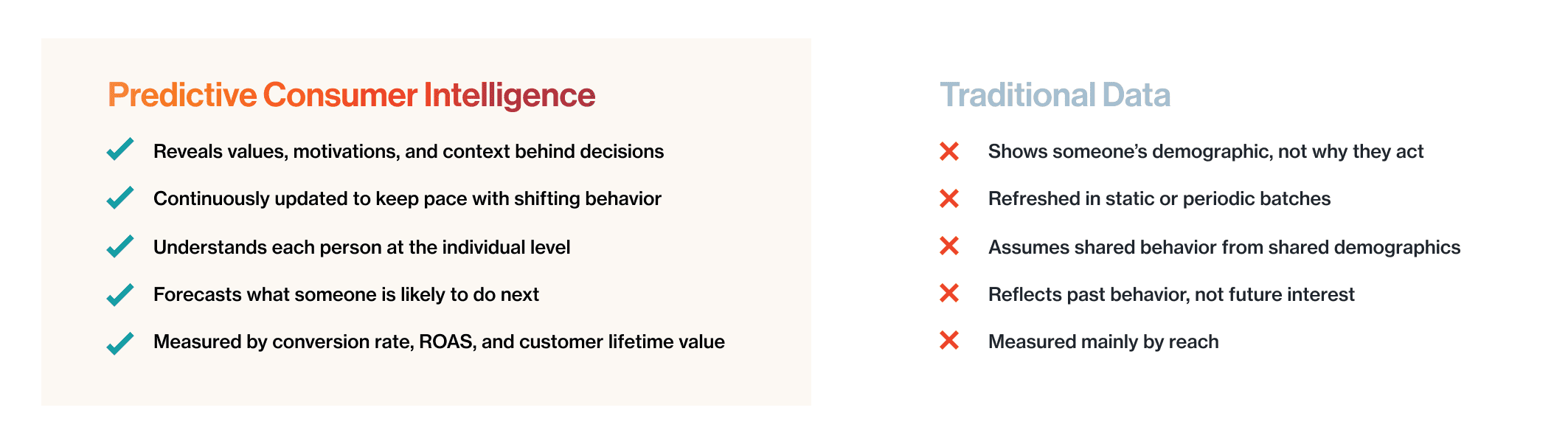
Typical first-party data is largely demographic. It tells you what your customers bought, how much they spent, and where they lived when they made a purchase. In other words, it’s a snapshot of the past that puts a ceiling on how you engage your customers. Contrast this with predictive consumer intelligence (PCI), which uses values, motivations, and up-to-date context to understand what customers will do next.
Create a side-by-side comparison of what’s possible with PCI versus what’s possible with the traditional data you have now. The differences are the outline of your value pitch, and the gap between the sides is the business risk. It might look something like this:
Having this deep understanding of what you’re asking for will make the four-step process for building the case internally much easier. Let’s take a look at what you need to do so you can stop waiting for a budget cycle that may never come and start driving revenue growth today.
How to Get the Budget You Need to Succeed
Step 1: Start with what you’re already spending
Start with auditing and documenting your current data and martech spend in full, including both the cost and the benefit analysis that was used to justify the original spend. You’ll likely find at least one line item that doesn’t have a clear performance case attached to it or that is underperforming relative to investment. Reframing the conversation with leadership as, “We need to spend what we already have better” is an easier argument to make than, “We need more money.”
It’s also wise to go one step further and see where in the process you’re overlooking opportunities for revenue growth. You already identified some of these growth drivers (and the challenges slowing you down) when you made your initial pitch, but your audit of existing tools will make it easier to attach real dollars to your recommendations.
Step 2: Build the performance case before you ask for anything
This point brings us to the second step: Build a performance case using your own numbers.
Take new customer acquisition, for instance. This is an expensive endeavor for any company, and it’s far less costly to keep loyal consumers over the course of their lifetime. Customer retention also drives significant revenue. You know it’s true, but grounding this narrative in real-world figures proves it.
By showing your current cost-per-customer figures alongside the tangible costs of churn, you can demonstrate need in concrete terms that are hard to refute. PCI thus becomes a necessity because it:
- Helps you target more of the right prospects faster, lowering CAC
- Reduces churn by surfacing signals in time to intervene
- Builds loyalty with more precise messaging, creative, offers, or services
It’s also important to measure your current targeting performance against external benchmarks, not just your own prior year. Year-over-year internal comparisons obscure whether you’re actually performing well or just incrementally improving a weak baseline. For example, if your CTR improved 15% year-over-year but the category benchmark is three times your absolute rate, you have a bigger problem than you realized.
Make sure your performance case includes what the new solution or data is projected to achieve, too. If possible, it’s helpful to use a results-driven case study to craft a really strong argument.
Step 3: Quantify what a 1% improvement is worth
Take your current campaign revenue or conversion value and calculate what a 1% improvement in targeting precision would be worth in real dollars. If your campaigns produce $5M in attributed revenue annually, a 1% improvement is $50,000. A 5% improvement is $250,000. If the cost of what you’re asking for is less than the conservative end of that range, the investment pays for itself.
Put that number in the first slide of your budget conversation, not in the appendix. Your case will be stronger in the eyes of leadership when they can see a clear dollar return.
Step 4: Make sure you can answer these questions
Before you walk into a budget conversation, you should have clear, detailed answers to the following:
- What are our current tools, methods, and models actually producing in terms of revenue?
- Which tools in our current stack don’t have a documented performance case and are candidates for reallocation to fund something that works demonstrably better?
- Where in the revenue pipeline could we drive significantly more growth if we made one change?
When you’re able to answer all of these clearly and specifically, you’ve moved from asking for more money to crafting a strong argument for the tools you need to achieve the growth executives want to see.
Ready to Get Started?
If you’re ready to build your case, it helps to choose a product and partner that can stand up to the scrutiny of a contested budget pitch.
Resonate’s predictive consumer intelligence enriches the demographic data you already have with values, motivations, purchase intent, and life context. This makes it possible to know what your customers will do next and get there before your competitors. Best of all: the Resonate difference can be measured in real outcomes and real dollars.
If you’re tasked with driving revenue and need help pushing back on budgetary restrictions, schedule a consultation today for the proof your pitch needs.